
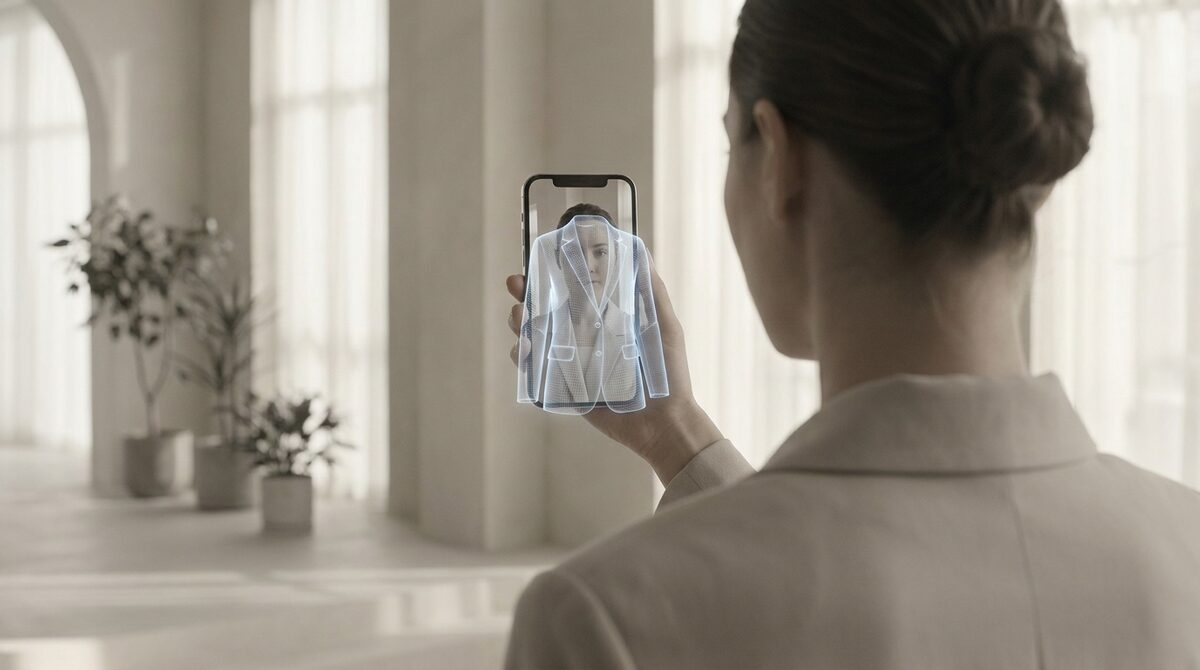
AR digital fashion renders garments onto a real shopper through augmented reality — bridging digital clothing and physical retail. With 1Match, that render powers a growth engine: it captures a first-party lead, feeds funnel analytics, and runs zero-storage / GDPR-safe. The result looks digital-native but sells real products.
What AR digital fashion means for a store
The term covers a spectrum. At one end sits digital-only clothing that is never physically worn; at the other, practical retail AR that puts your real, sellable garments onto shoppers. For a Shopify merchant, the commercial version is what matters: an AR-rendered preview of an actual product on the actual customer. That is where the buying decision is won or lost.
How the render happens
The system detects the shopper’s body, face or hands, then maps the garment on with realistic proportion and drape, returning a high-quality image in seconds. Crucially, AI-based AR digital fashion works from your existing product photos — no 3D, no reshoot. If you want the technical walkthrough, read how an AI clothes changer works.
Why realism is the whole game
Digital fashion can look striking, but retail AR only pays off when the shopper trusts what they see. That trust comes from strong image quality — believable lighting, fit and texture rather than a flat overlay. The same engine also covers hands, face and body, so rings, glasses, hats and clothes all render from one consistent tool.
From preview to purchase
The payoff is measurable. Realistic AR previews cut returns roughly 25–40% and lift add-to-cart 18–28%, because fit-and-size doubt — behind around 70% of apparel returns — is answered at the product page. Add native lead capture and funnel analytics and every try-on becomes data you can act on. For the wider landscape, see the complete guide to virtual try-on and our best virtual try-on apps for Shopify in 2026.
Getting started
Install 1Match, connect your existing images, and switch on the try-on button in about ten minutes. There is no production pipeline and no developer required.
Where digital and physical fashion meet
The most useful way to think about AR digital fashion is as a bridge. On one side sit purely digital creations; on the other, physical garments a shopper can buy and wear. Retail AR lives on the bridge, rendering real products with a digital-native polish. It borrows the creativity of digital fashion while staying tethered to something the shopper can actually own, which is what makes it commercially meaningful rather than merely decorative.
For merchants, this framing clarifies the investment. You are not buying an art project; you are buying a way to present real inventory more convincingly. The digital layer exists to sell the physical product, not to replace it.
Keeping it scalable across a catalogue
Scalability is where AI approaches pull ahead. Because the render is generated from existing product photos, extending AR digital fashion from ten products to ten thousand does not multiply your production costs. There is no per-item modelling and no reshoot, so a growing catalogue stays fully covered by one 10-minute setup rather than an ever-expanding asset pipeline.
The takeaway for merchants
AR digital fashion is most valuable when the digital polish is in service of a real, sellable product. Keep the render tethered to something the shopper can own, insist on zero-storage / GDPR-safe handling, and make sure it scales from photos rather than 3D. Do that and the aesthetic upside comes with a commercial one.
It is the rare feature that looks futuristic and pays back in plain, measurable terms.
Bottom line: AR digital fashion is most valuable when it sells real products — previews that double as a Shopify growth engine with native leads and funnel analytics, kept zero-storage and GDPR-safe. Put it to work with 1Match.
Frequently asked questions
What is AR digital fashion?
AR digital fashion uses augmented reality to place digital or catalogue garments onto a real person before purchase. It bridges digital-only clothing concepts and physical retail by rendering items onto the shopper’s body. For stores, the practical version shows real products on real customers to aid the buying decision.
How is AR digital fashion different from digital-only fashion?
Digital-only fashion exists purely as imagery or NFTs and is never worn physically. AR digital fashion, in a retail sense, renders your actual sellable products onto shoppers so they can decide to buy. The value is commercial: fewer returns and higher confidence, not just visual novelty.
Do I need 3D assets for AR digital fashion?
Not with an AI-based tool. 1Match works from your existing product photos, so there is no 3D modelling and no reshoot. That keeps setup to about ten minutes and lets you cover a full catalogue without a production pipeline.
Is AR digital fashion safe for shopper data?
It should be. 1Match is zero-storage and GDPR-safe, using the shopper photo only to generate the preview and not retaining it. Confirm any provider’s policy before enabling a camera or upload feature.
 Install on Shopify