
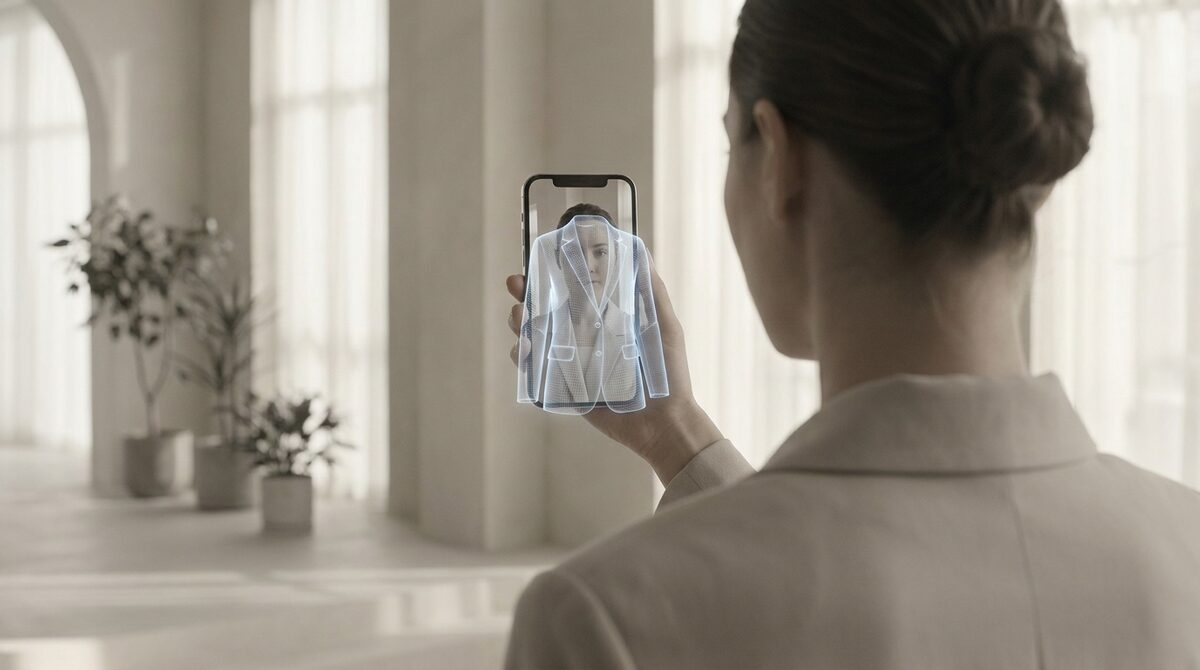
In AR vs VR for fashion, AR overlays garments onto the real shopper while VR builds a virtual world. For selling, AR try-on wins — and with 1Match it drives a growth engine: native first-party leads, funnel analytics, and zero-storage / GDPR-safe handling. VR is for spectacle; AR is for the sale.
AR vr fashion: the core distinction
The difference is where the shopper is. AR keeps them in the real world and adds the product — a jacket on their shoulders, glasses on their face, seen through a phone. VR removes the real world and drops them into a virtual environment. Both are impressive, but they solve different problems, and confusing them wastes budget.
Why AR wins the product page
Shoppers browse on phones, so the tool that works on a phone wins the everyday sale. AR try-on renders a garment onto the shopper from their own photo, working from your existing product photos with no 3D and no reshoot. There is nothing to download and no headset to own. See the virtual fitting room explained for how it feels in practice.
Where VR still earns its place
VR is not useless — it is excellent for immersive showrooms, virtual runways and launch events that generate press and brand memory. The limitation is reach: headset ownership is low, so VR rarely touches the product page where conversion happens. Treat it as a campaign tool, not a checkout tool.
Side by side
| AR try-on | Fashion VR | |
|---|---|---|
| Device | Any phone | Headset |
| Setup | ~10 min | Heavy 3D |
| Best for | Conversion, fewer returns | Showrooms, events |
| Data value | Leads + funnel analytics | Limited |
For the tool landscape, read the complete guide to virtual try-on and our best virtual try-on apps for Shopify in 2026.
The practical call
If the question is what to actually use this quarter, the answer is AR try-on. It cuts returns 25–40%, lifts add-to-cart 18–28%, and turns each interaction into a lead and a data point — all while staying zero-storage and GDPR-safe.
Budget: where each dollar goes furthest
Money spent on VR buys immersion for a comparatively small, headset-owning audience. Money spent on AR try-on buys confidence for nearly every shopper, on the phone they already use. For most fashion merchants, the per-conversion return on AR is simply higher, because reach is not gated by hardware. That does not make VR a waste — it makes it a specialist spend rather than a default one.
A sensible allocation treats AR try-on as core storefront infrastructure and VR as an occasional campaign line item. That keeps the everyday growth engine funded while leaving room for the occasional immersive showpiece.
Future-proofing your choice
Adopting AR try-on now does not close the door on VR later. The data you gather — leads, funnel behaviour, which products benefit from previews — remains valuable whatever hardware the future brings. By building on zero-storage / GDPR-safe AI try-on today, you get results immediately and stay flexible as immersive tech matures.
The one-line answer
If you can only fund one, fund AR try-on — it reaches every shopper, cuts returns and lifts carts on the phone they already hold, while VR waits on hardware most people do not own. Keep VR for the campaign moment and let AR try-on be the daily growth engine. That split gets the most from every dollar.
Adopt AR now and you lose nothing by exploring VR later; the data you gather stays useful either way.
Bottom line: in AR vr fashion, run VR for spectacle and AR try-on as your Shopify growth engine — previews plus native leads and funnel analytics. Start with 1Match.
Frequently asked questions
What is the difference between AR and VR in fashion?
AR overlays digital garments onto the real shopper in their own photo or camera, while VR immerses them in a fully virtual environment. AR is lightweight and phone-friendly; VR needs a headset and heavy 3D assets. For online selling, AR-based try-on is the practical everyday tool.
Is AR or VR better for a fashion store?
For everyday conversion, AR wins because shoppers can use it on the phone they already hold. VR suits flagship showrooms and campaigns. Most merchants get the best return from AI try-on that renders products onto shoppers from existing photos.
Do AR and VR both reduce fashion returns?
Realistic AR try-on measurably reduces returns — typically 25–40% — because it answers fit at the product page on devices everyone owns. VR’s impact on returns is limited by low headset adoption, so it is not the primary return-reduction tool.
How hard is it to add AR or VR to Shopify?
VR requires 3D assets and often custom development. AR via AI try-on is far simpler: 1Match works from your existing product photos and installs in about ten minutes, covering body, face and hands from a single tool.
 Install on Shopify