
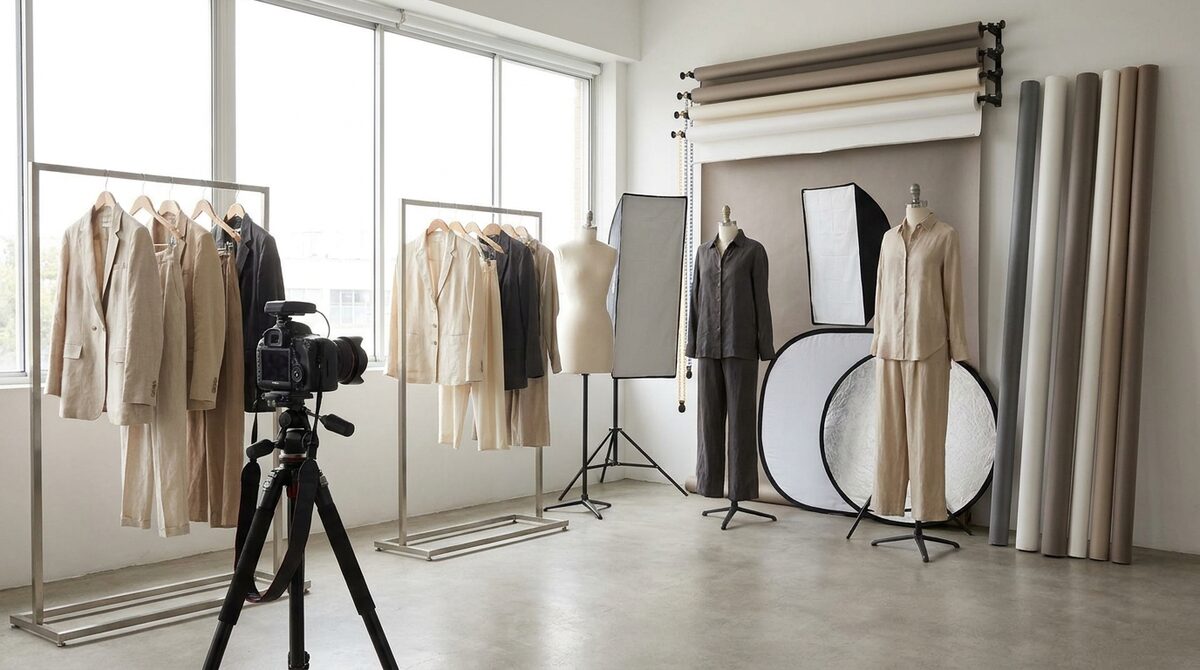
Clothing photography is the craft of shooting apparel so it looks accurate, appealing, and consistent across a catalog — flat lay, ghost mannequin, or on-model. But a photo can only sell the look; it can't confirm the fit. That is why the smartest fashion stores pair strong clothing photography with a virtual try-on app like 1Match, which turns your existing photos into a growth engine: shoppers see garments on their own body, you capture first-party leads, funnel analytics reveal what converts, and every shopper photo stays zero-storage and GDPR-safe.
The three pillars of clothing photography
Almost every apparel catalog is built from three shot types, and knowing when to use each is most of the battle.
1. Flat lay
Pros: cheap, fast, and endlessly consistent — ideal for detail and color accuracy.
Cons: shows no drape or fit, so it under-sells how a garment moves on a body.
Verdict: perfect for high-volume catalog work and secondary detail images.
2. Ghost mannequin
Pros: shows 3D shape and structure without a model, clean and professional.
Cons: requires careful editing to composite front and back; still no human context.
Verdict: the workhorse hero shot for many Shopify apparel stores.
3. On-model
Pros: shows fit, drape, and styling in real context — the most persuasive.
Cons: expensive, slow, and each model represents only one body type.
Verdict: essential for hero looks, but hard to scale across every SKU and size.
Getting clothing photography right
The fundamentals are unglamorous but decisive: soft, even lighting; true white balance so colors don't shift; a consistent background and crop; and steaming or pinning garments so wrinkles don't read as defects. Consistency beats creativity here — a catalog that looks like one brand converts better than a catalog of individually clever shots.
For editing discipline that keeps that consistency, our note on truthful post-production is worth a read alongside this piece.
The gap clothing photography can't close
Even flawless clothing photography answers only one question: what does this look like? It cannot answer the question that actually drives the purchase — what does this look like on me? A single stock model represents one height, one size, one skin tone. Everyone else is guessing, and guessing is what fuels the roughly 70% of apparel returns that are fit or size related.
From clothing photography to virtual try-on
This is the modern next step. Virtual try-on takes the same clothing photography you already produce and renders each garment on the shopper's own uploaded photo — no 3D, no reshoot, working directly from existing product images. Because 1Match covers hands, face and body, it handles rings, glasses, hats and full outfits, not just tops. If you want the mechanics, see how an AI clothes changer works, and for the shopper's side, the virtual fitting room explained.
The payoff: fewer returns, more add-to-cart
When shoppers confirm fit on themselves, surprise drops and confidence rises. Stores that add try-on typically see 25–40% fewer apparel returns and an 18–28% lift in add-to-cart. Your clothing photography is the raw material; try-on is what makes it earn. For the numbers behind that, see our try-on ROI guide for Shopify.
How to combine both without overspending
Shoot clean, consistent clothing photography for your top sellers, then layer try-on on those exact products. Setup takes about 10 minutes with strong image quality out of the box, so you can measure the lift before scaling. The result is a Shopify growth engine: photography that shows the look, try-on that confirms the fit, native lead capture, funnel analytics, and zero-storage, GDPR-safe photos. Add it in an afternoon with 1Match.
Frequently asked questions
What are the main types of clothing photography?
The three staples are flat lay (garment laid out), ghost mannequin (invisible-mannequin 3D effect), and on-model (worn by a person). Most stores mix them: flat lay or ghost mannequin for detail and consistency, on-model to show drape and fit in context.
What lighting is best for clothing photography?
Soft, even lighting is the standard, usually large diffused softboxes or bright indirect daylight, to avoid harsh shadows and keep color true. Consistency across the catalog matters more than any single fancy setup, so lock your lighting and reuse it for every SKU.
Do I still need on-model clothing photography if I use try-on?
You need fewer on-model shots, not zero. A clean product image is enough for an AI try-on tool to render the garment on a shopper's own body, which covers the personalized 'how does it look on me' question far better than a single stock model ever could.
How does clothing photography affect returns?
Photos set expectations; when the real item doesn't match, it comes back. Accurate color and true-to-life drape reduce surprise, and adding virtual try-on so shoppers confirm fit on themselves is the strongest single lever, cutting apparel returns by roughly 25 to 40 percent.
 Install on Shopify