
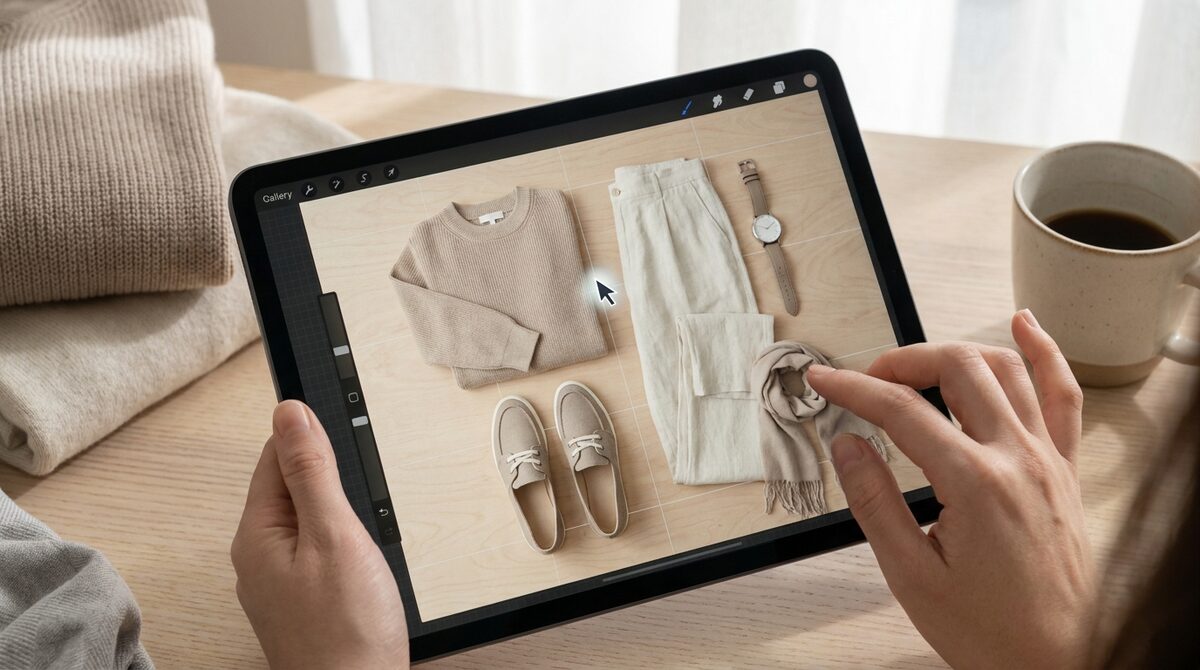
Simulation beats imagination
Online, shoppers are asked to simulate outfits in their head, and heads are unreliable. An outfit simulator does the simulating for them, showing the full look on their body so nothing is left to imagination. What you see is what arrives.
That reliability is the entire pitch. The single biggest reason apparel gets returned is that reality did not match expectation. A simulator collapses the gap between the two before any money changes hands.
How an outfit simulator works
An outfit simulator reads garments from product photos and renders them onto the shopper's own image, accounting for drape, proportion, color, and texture. The best ones handle full looks, not just one item.
1Match runs this on a 2D pipeline with strong image quality, no 3D avatars, no reshoot, covering hands, face, and body so accessories simulate too. It works from your existing catalog and sets up in about 10 minutes. See the rendering mechanics.
What a simulator does for the business
The headline win is returns. By letting shoppers simulate the outfit first, stores typically cut returns 25 to 40%, protecting margin that discounts and marketing cannot recover. Our returns guide shows how the savings add up.
Simulation also lifts confidence to buy, adding 18 to 28% to add-to-cart. And every simulated look is a data point: native lead capture and funnel analytics turn that behaviour into first-party insight, all zero-storage and GDPR-safe.
How realistic can an outfit simulator get?
Realism is the whole game for an outfit simulator, because an unconvincing preview is worse than none, it erodes trust. Two things drive realism: the quality of the rendering engine and the quality of the input images. Get both right and the simulation is hard to distinguish from a photo.
1Match focuses its 2D pipeline on faithful drape, color, and texture rather than novelty 3D effects. That choice keeps results grounded and believable, and it extends across hands, face, and body so accessories simulate as convincingly as the main garment.
The realism test is simple: would the shopper be surprised when the parcel arrives? A good outfit simulator makes the answer no. That alignment between preview and reality is exactly what drives the 25 to 40% drop in returns that try-on stores report.
Adding an outfit simulator to your store
Old simulators needed 3D scans and heavy production. A modern outfit simulator like 1Match skips all of it, working from photos you already have with a fast setup. Pilot it on a returns-heavy collection to see the impact clearly.
If you want to compare simulators against other try-on formats, our roundup of Shopify try-on apps covers the landscape.
Where an outfit simulator moves the needle most
An outfit simulator earns its keep hardest in high-return categories: fitted apparel, occasionwear, denim, and anything where a shopper's biggest fear is that it will not look right on them. Simulating the look upfront defuses exactly that fear.
It also shines for higher-priced items, where the cost of a wrong purchase, and the pain of a return, is greatest. Giving the shopper a realistic on-body preview before they commit protects both their confidence and your margin.
Start there. Enable the simulator on your most returned or highest-consideration collection first, measure the drop in returns and the lift in add-to-cart, then expand across the catalog. With 1Match running from existing photos in about 10 minutes, that pilot costs you an afternoon.
The bottom line on outfit simulators
An outfit simulator succeeds or fails on realism, because the entire promise is that what the shopper sees is what arrives. Faithful rendering across the full look is what closes the gap between expectation and reality.
Deploy it first where returns and hesitation are highest, prove the drop in returns, then scale. With 1Match running from existing photos, that proof costs an afternoon, not a quarter.
An outfit simulator replaces "I hope this looks good" with "I can see it does." 1Match brings it all together as a Shopify growth engine: virtual try-on that renders looks on the shopper with strong image quality, plus native lead capture, funnel analytics, and zero-storage, GDPR-safe processing, all live in about 10 minutes with no 3D or reshoot. Try 1Match on the Shopify App Store and turn browsing into buying.
Frequently asked questions
What is an outfit simulator?
An outfit simulator shows how a complete look would appear on a person before they buy it. The strongest simulators render on the shopper own photo rather than a generic avatar, so the preview is genuinely representative.
How accurate is an outfit simulator?
Accuracy depends on the engine. 1Match uses a 2D photo pipeline focused on strong image quality, rendering garment drape, color, and texture on the shopper photo without 3D avatars, which keeps the result realistic.
Does an outfit simulator reduce returns?
Yes. Because most apparel returns stem from fit and appearance surprises, simulating the outfit on the shopper before purchase removes much of that uncertainty, cutting returns by roughly 25 to 40%.
Can I add an outfit simulator to Shopify easily?
With 1Match, yes. It installs in about 10 minutes, runs on your existing product photos, and needs no 3D modelling or reshoot. It also captures leads and feeds funnel analytics as shoppers simulate looks.
 Install on Shopify