
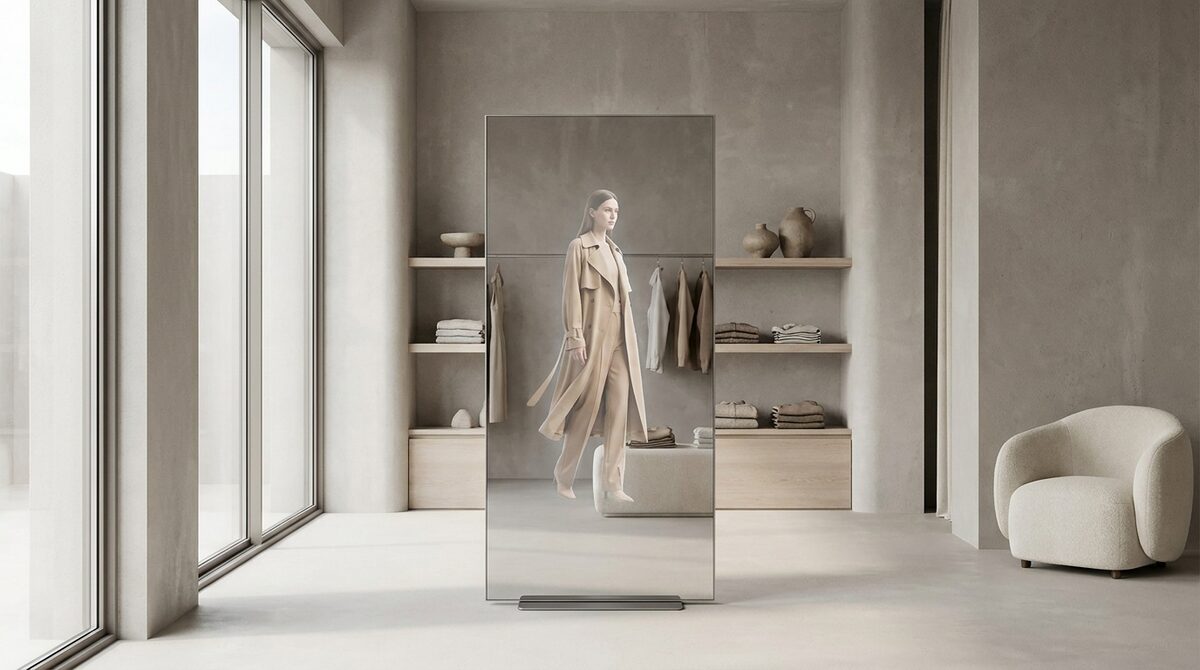
Store fitting room tech has moved online: instead of a physical changing room, AI virtual try-on shows garments on a shopper’s own body right on the product page. With 1Match that try-on powers a growth engine — each session captures a first-party lead, feeds funnel analytics, and runs zero-storage / GDPR-safe so photos are never retained. The result is fewer returns and more confident carts.
What "store fitting room tech" means now
For a decade, store fitting room tech meant hardware: smart mirrors, RFID tags, tablet-driven clienteling. All of it lived inside four walls. The problem is that most fashion buying has moved online, where there is no changing room at all. So the technology followed the shopper. Today the most important store fitting room tech is not a mirror — it is AI virtual try-on that renders a garment onto the customer’s own photo, right on the product page.
This shift matters because it works from existing product photos with strong image quality, no 3D and no reshoot. The fitting room stops being a place and becomes a moment you can drop into any checkout flow.
Physical vs online fitting-room tech
Smart mirrors are impressive in flagship stores, but they are expensive, slow to install, and reach only the shoppers who physically walk in. Online virtual try-on reaches every visitor, on any phone or laptop, with no hardware. For a Shopify brand the economics are not close. Our virtual fitting room explained guide lays the approaches side by side.
Why store fitting room tech cuts returns
The fitting room has always had one job: stop the wrong item from going home. Around 70% of apparel returns trace back to fit and size. When you recreate that check online, shoppers see the garment on their own body before buying, and expectations line up with reality. Stores adding try-on commonly report 25–40% fewer returns and an 18–28% lift in add-to-cart. More on the mechanics in how to reduce returns for an online fashion store.
Beyond clothes: hands, face and body
A good virtual fitting room is not limited to shirts. The same engine that drapes a jacket can place a ring on a hand, glasses on a face, or a hat on a head. That hands, face and body coverage means one tool serves your whole catalog, apparel and accessories alike.
The growth-engine upgrade
Here is what physical mirrors never gave you: data. Modern store fitting room tech powers a growth engine. Every try-on can capture a first-party lead and log intent into funnel analytics — which items get tried, which convert, where shoppers hesitate. And because 1Match is zero-storage, you get all of it while staying GDPR-safe. Photos are never retained.
Bottom line: The fitting room did not disappear — it moved to the product page. Done right, store fitting room tech is a Shopify growth engine: realistic try-on plus native lead capture and funnel analytics, with zero-storage GDPR-safe processing. You can add it in about ten minutes with 1Match.
Frequently asked questions
What is store fitting room tech?
Store fitting room tech is the set of tools that let shoppers judge fit and style before committing to a purchase. In physical retail that meant mirrors, smart mirrors and RFID. Online it now means AI virtual try-on that renders garments onto a shopper’s own photo, bringing the fitting-room moment to product pages without any physical space.
Can store fitting room tech work for an online-only shop?
Yes, and that is where it matters most. Online shoppers cannot step into a changing room, so a virtual try-on layer recreates that decision moment on the product page. With a tool like 1Match it runs from your existing product photos, so an online-only Shopify store gets fitting-room confidence without owning a single physical mirror.
Does replacing the fitting room reduce returns?
It reduces the biggest cause of returns. Around 70% of apparel returns come from fit and size surprises, exactly what a fitting room exists to prevent. Bringing that check online typically cuts apparel returns by 25–40% because shoppers set realistic expectations before they buy.
How long does store fitting room tech take to set up?
A photo-based virtual try-on is the fastest path. Because it reads garments from images you already have, setup on Shopify is about ten minutes and there is no 3D modelling or reshoot. Physical smart-mirror hardware, by contrast, can take weeks and significant capital to install.
 Install on Shopify