
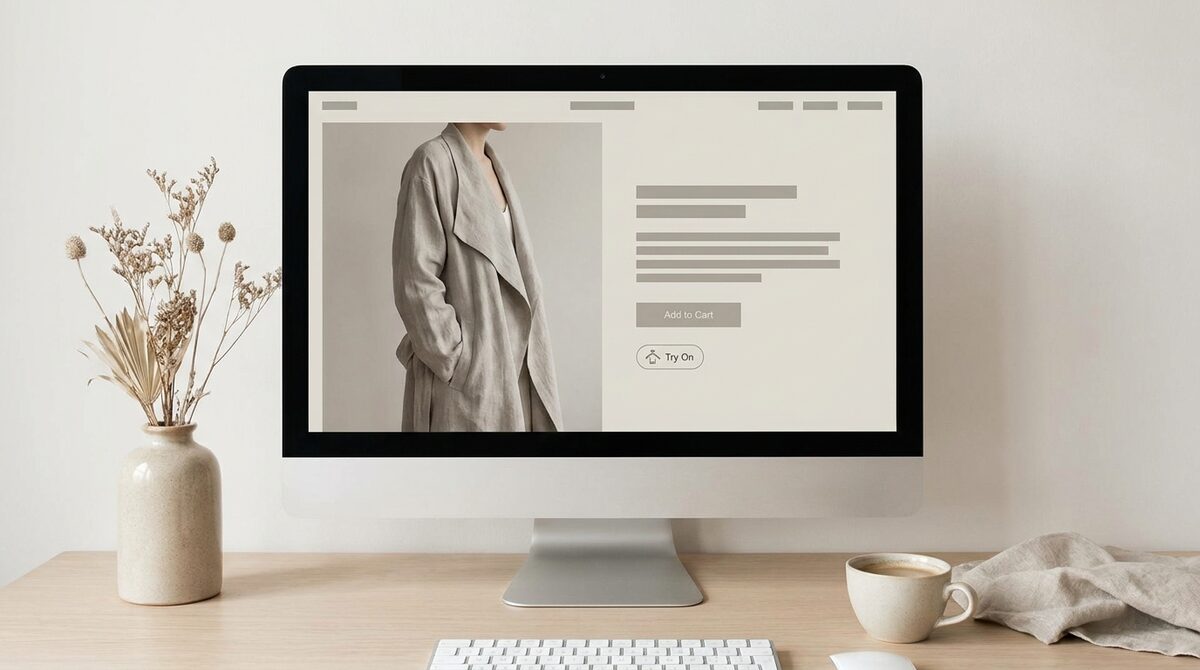
You can now try clothes before you buy online: AI virtual try-on renders the garment onto a photo of your own body, so you judge fit and style instead of guessing. For the store, each try-on with 1Match turns a browser into a growth engine — it captures a first-party lead, feeds funnel analytics, and runs zero-storage / GDPR-safe so no shopper photo is kept.
Why you should try clothes before you buy
Online fashion has one stubborn flaw: the product photo shows the garment on someone who is not you. Different height, different shape, different coloring. That gap is where doubt lives, and doubt is why carts get abandoned and parcels get returned. The ability to try clothes before you buy closes the gap by putting the item on your body first, so the decision is based on what you actually see rather than what you hope.
It matters because fit is the number one reason clothes come back — roughly 70% of apparel returns are down to fit or size. When you can preview the real result, most of that uncertainty disappears before you ever reach checkout.
How to try clothes before you buy, step by step
The experience is simpler than a physical fitting room. On a store that offers virtual try-on you tap the try-on button, add a clear photo of yourself, and within seconds the garment appears on you with correct proportion and drape. Because modern tools work from existing product photos — no 3D, no reshoot — almost any item in the catalog can be previewed this way.
If you want the mechanics behind that preview, our guide to how an AI clothes changer works walks through the rendering step in plain language.
What a virtual try-on can and cannot tell you
A strong virtual try-on answers the questions that flat photos cannot: does this color work with my skin tone, is the length right for my frame, does the cut suit my shape. Thanks to strong image quality, the preview reads like a real photo rather than a sticker, which is what makes it trustworthy enough to buy from.
What it will not do is measure the exact tension of a waistband. For that final sizing call, combine the visual preview with the store’s measurements — our notes on effective size guides explain how the two work together.
Fit, face and hands — not just clothes
The same idea extends beyond garments. The engine that dresses a torso can place glasses on a face, a hat on a head, or a ring on a hand, so hands, face and body are all covered. Whatever the item, being able to try it before you buy means you commit only when you can already picture yourself wearing it.
Why the old workarounds fall short
Shoppers have always tried to reduce the risk themselves — reading reviews for “runs small,” ordering two sizes to return one, or sticking to a single brand they already know. Each of these has a cost. Reviews describe someone else’s body, buying doubles ties up money and guarantees a return trip, and brand loyalty quietly narrows your choices. The ability to try clothes before you buy replaces all of those hedges with one direct answer: this is how the item looks on you, right now, before any money changes hands.
It also changes how you browse. Instead of skimming past anything that looks risky, you can preview the bolder color or the unfamiliar cut, because the downside of being wrong has disappeared. That freedom to experiment is good for shoppers who want more from their wardrobe and good for stores that want their full range to be seen.
Fewer returns, more confidence
The payoff is measurable on both sides. Shoppers keep more of what they order, and stores see roughly 25–40% fewer returns alongside an 18–28% add-to-cart lift because hesitation drops. The quieter win is data: every try-on can capture a first-party lead and feed funnel analytics that show which products convince and where people stall. To see which tools do this best, compare our best virtual try-on apps for Shopify fashion in 2026.
For merchants, letting customers try clothes before they buy is not a gimmick — it is a Shopify growth engine that pairs try-on with native lead capture, funnel analytics and zero-storage privacy, live in a 10-minute setup with 1Match.
Frequently asked questions
Can you really try clothes before you buy online?
Yes. AI virtual try-on lets you try clothes before you buy by rendering a garment onto a photo of your own body, so you see how it looks on you rather than on a model. The store keeps its normal checkout — the try-on simply happens on the product page. It replaces guesswork with a realistic preview in seconds.
How accurate is a virtual try-on compared with a real fitting room?
A good virtual try-on shows accurate proportion, drape and color on your body, which is enough to settle most “will it suit me?” doubts. It will not measure tension across a seam like a physical fitting room, so pair it with the store’s size guide for the final call. For appearance and styling decisions, it is remarkably close to the real thing.
Is it safe to upload my photo to try clothes before I buy?
With a zero-storage tool like 1Match, your photo is processed to generate the preview and not retained, which keeps the experience GDPR-safe. Always check that the store uses a privacy-respecting provider before uploading. Reputable virtual try-on apps never sell or keep shopper images.
Does trying clothes before you buy reduce returns?
Yes. Because around 70% of apparel returns come down to fit or size, seeing the item on yourself first removes the main reason people send things back. Stores using virtual try-on typically see 25–40% fewer returns and an 18–28% lift in add-to-cart. Shoppers buy with more confidence and keep more of what they order.
 Install on Shopify