
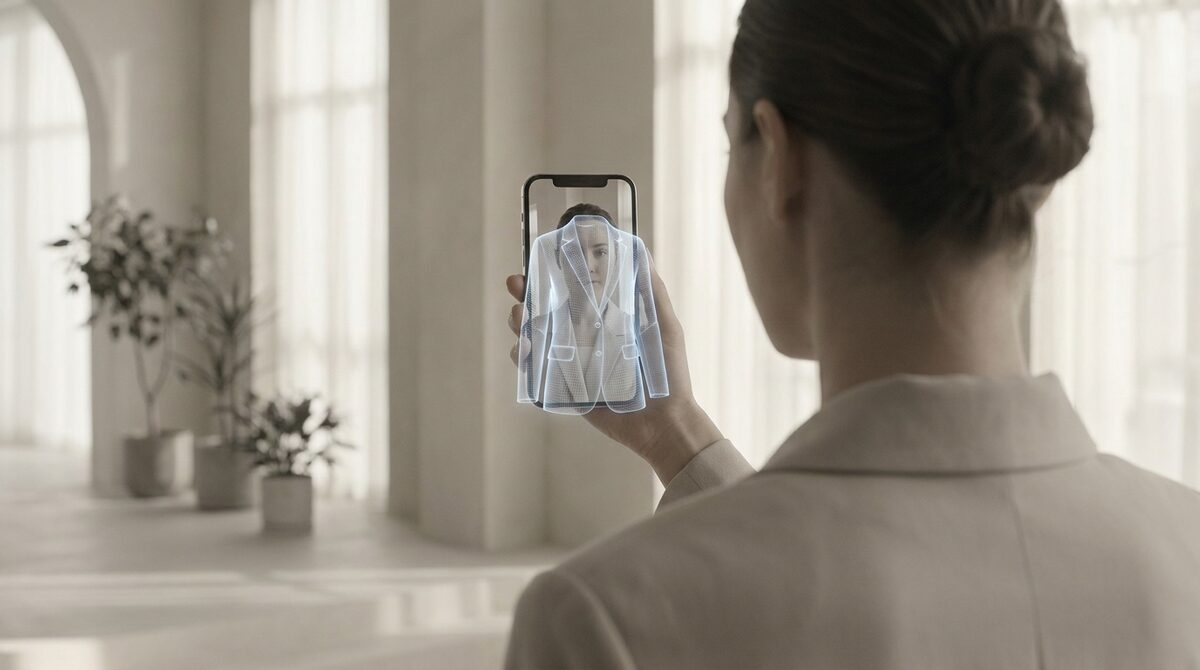
Virtual reality clothes shopping turned out to need no headset at all: browser-based AI try-on lets shoppers see garments on their own body in seconds. With 1Match that experience also powers a growth engine — each try-on delivers a first-party lead, enriches funnel analytics, and stays zero-storage / GDPR-safe. It is the payoff VR promised, minus the hardware.
What virtual reality clothes shopping actually became
The early vision of virtual reality clothes shopping involved goggles and digital malls. What actually scaled was quieter and far more useful: AI try-on inside the normal storefront. A shopper uploads a photo, and the garment is rendered onto them from your existing product images — no 3D, no reshoot, no headset. The immersive part that mattered (seeing yourself in the item) survived; the awkward hardware did not.
If you want the wider category context, our complete guide to virtual try-on for fashion stores maps how these technologies converged.
How browser-based try-on beats headset VR for retail
For apparel, friction kills conversion. Headset VR adds friction; browser try-on removes it. Because it runs on the device the shopper already holds, virtual reality clothes shopping in its modern form reaches everyone, not just the small slice who own a headset. It also loads on the product page where the buying decision happens, instead of a separate app.
Tools leading virtual clothes shopping in 2026
1. 1Match
Pros: Fashion-first AI try-on with strong image quality, works from existing product photos, covers hands, face and body (rings, glasses, hats, clothes), 10-minute Shopify setup, native lead capture and funnel analytics, zero-storage / GDPR-safe.
Cons: Focused on photo-based try-on rather than full immersive VR environments.
Verdict: The most practical way to give a Shopify store the “try before you buy” payoff of VR without any hardware.
2. Headset VR showrooms
Pros: Fully immersive, good for flagship brand experiences and events.
Cons: Requires a headset, tiny reachable audience, expensive to build, poor fit-accuracy for everyday buying.
Verdict: A marketing showpiece, not a conversion tool for most stores.
3. Static 3D configurators
Pros: Lets users rotate a garment in 3D.
Cons: Shows the product, not the shopper; needs 3D modelling per SKU; no personal try-on.
Verdict: Useful for detail, weak for the “on me” confidence that drives sales.
| Approach | Hardware | Sees you on the item | Setup effort |
|---|---|---|---|
| AI try-on (1Match) | None | Yes | ~10 min |
| Headset VR | Headset | Sometimes | High |
| 3D configurator | None | No | Per-SKU modelling |
The business case
Virtual reality clothes shopping is a commercial decision, not a tech demo. The reason to add it is money: 25–40% fewer returns and an 18–28% add-to-cart lift because shoppers stop guessing. Layer in first-party lead capture and funnel analytics and each try-on compounds into data you own. For the returns math specifically, see reduce returns for an online fashion store.
Bottom line: The future of virtual reality clothes shopping is already here — it just lives in the browser. Treat it as a Shopify growth engine (try-on plus native leads plus funnel analytics, all zero-storage and GDPR-safe) and enable it in minutes with 1Match.
Frequently asked questions
What is virtual reality clothes shopping?
Virtual reality clothes shopping refers to previewing and buying garments in an immersive digital environment where you can see items on yourself or a digital model. In practice the mainstream form is not headset VR but browser-based AI try-on, where a shopper uploads a photo and sees clothing rendered on their own body. It gives the core benefit of VR — seeing before buying — without any hardware.
Do I need a VR headset to shop for clothes virtually?
No. Almost all practical “virtual” clothes shopping today runs in a normal web browser on a phone or laptop. AI try-on tools render garments onto your photo instantly, so you get the try-before-you-buy experience without buying or wearing any device. Headset-based VR remains niche for apparel retail.
Does virtual clothes shopping increase sales?
It typically does. By letting shoppers see fit and style on themselves, virtual try-on reduces hesitation at the product page. Stores commonly report an 18–28% lift in add-to-cart and 25–40% fewer returns, because expectations are set correctly before checkout.
Is virtual clothes shopping accurate?
Modern AI try-on is accurate enough to guide real purchase decisions, especially for style, proportion and drape. Image quality has improved sharply, and the best tools render from your existing product photos with realistic fit. It is not a tailor’s measurement, but it removes most of the guesswork that drives returns.
 Install on Shopify