
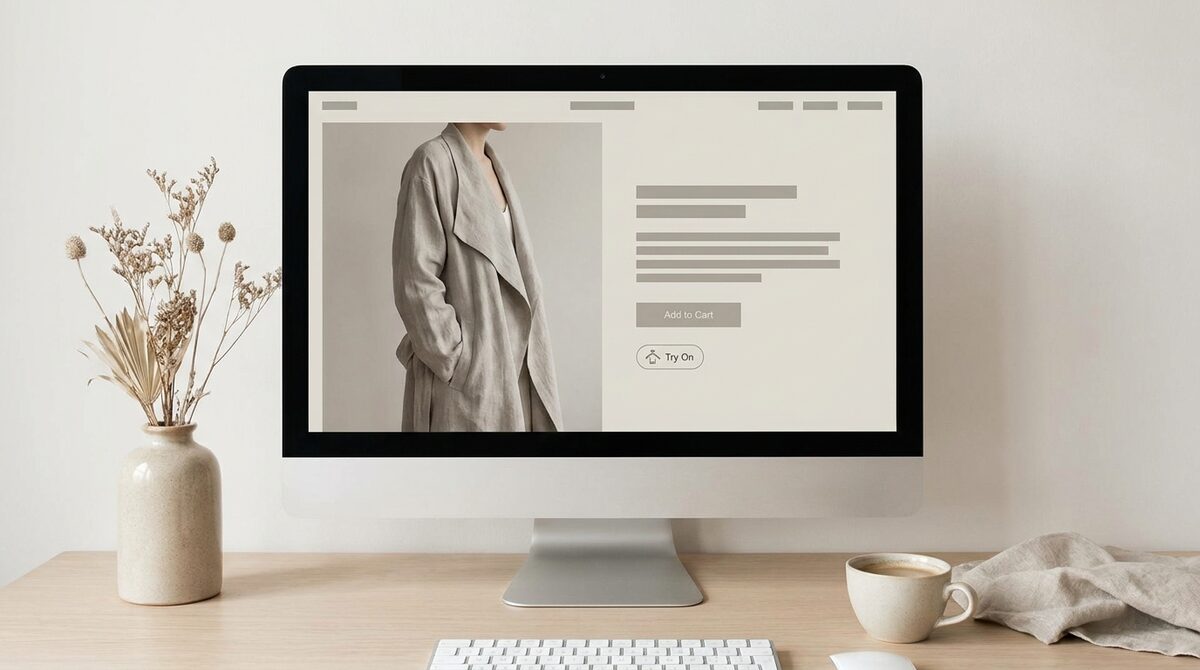
AI virtual try on uses generative models to read a shopper’s pose and proportions, then render a product onto their photo with realistic fit and drape — no 3D, straight from existing product images. Beyond a convincing preview, a well-built AI try-on drives growth: it converts hesitation into orders, captures first-party leads, feeds funnel analytics, and keeps uploads zero-storage and GDPR-safe.
The technology behind the image
AI virtual try on is a generative-imaging problem. The model interprets the shopper’s photo — body shape, pose, lighting — and re-renders the garment so it sits believably, with folds and shadows that match the person. Image-based approaches used by tools like 1Match work from existing product photos, so there is no 3D asset to build and no reshoot. Our how an AI clothes changer works breaks the pipeline down further.
Why image quality is the whole game
The difference between a try-on that converts and one that repels is fidelity. Strong image quality reproduces fabric texture, pattern continuity and natural lighting; weak models smear patterns and warp seams. Because shoppers decide in a glance, that realism is not cosmetic — it is the conversion mechanism. The virtual fitting room explained expands on what “good” looks like.
Where AI try-on excels
It is at its best judging look and proportion: how a dress silhouette falls, whether a jacket suits a frame, how glasses sit on a face. The same engine spans hands, face and body — rings, glasses, hats and clothes — which makes it useful across a fashion catalogue rather than one category.
Where it still trips up
Honest limits: extreme angles, very dark photos and intricate fine detail can reduce fidelity, and AI gives a visual rather than a measurement. It answers “will this suit me” far better than “is this exactly my size,” which is why an accurate effective size guides remains a partner, not a rival, to try-on.
Privacy by design
Generative try-on need not mean surveillance. A privacy-first tool processes the shopper photo to build the preview and never stores it, keeping the experience zero-storage and GDPR-safe. That design choice removes most of the privacy risk that worries shoppers.
From technology to results on Shopify
For merchants, the payoff is concrete. AI try-on installs in about ten minutes from existing photos, cuts returns 25–40% and lifts add-to-cart 18–28%. Our try-on ROI and return rates piece shows how those figures compound. Comparing options? Start with the best virtual try-on apps for Shopify.
Getting the best results from the AI
The output of any AI virtual try on is only as good as its inputs, and merchants control one side of that equation. Clean, well-lit, front-facing product photos give the model the most to work with, so patterns render sharply and edges stay crisp. If your catalogue images are consistent, the try-on results will be consistent too — one more reason the ten-minute setup pays off, since it reuses the photos you have rather than demanding new ones.
Shoppers control the other side. A clear photo with the relevant area visible — full body for garments, face for glasses, hands for rings — produces the most convincing render. The AI is robust to ordinary phone photos, but extreme angles and heavy shadow make its job harder. Communicating that gently in the try-on prompt nudges shoppers toward better photos and, in turn, better previews and higher confidence at checkout.
It is also useful to understand why the results keep improving. Generative models advance quickly, so an AI virtual try on built on a well-maintained engine gets better at fabric, lighting and edge cases over time without any work on your side. That is a genuine difference from older, rule-based fitting systems that were frozen at whatever quality they shipped with. Choosing a tool that rides those improvements means your previews grow more convincing season after season, on the very same catalogue photos, which quietly strengthens conversion and trust the longer you run it.
AI virtual try on is not just clever imaging — it is a Shopify growth engine that converts hesitation into orders, captures native leads, feeds funnel analytics, and stays zero-storage and GDPR-safe. See it in action with 1Match.
Frequently asked questions
How does AI virtual try on work?
It uses generative AI to understand a shopper’s pose and proportions from a photo, then re-renders a product image onto their body with realistic folds, shadows and fit. Image-based systems work from existing product photos and need no 3D model. The quality of the underlying model is what determines how convincing the result looks.
How accurate is AI try-on?
Strong engines are highly convincing for look, drape and proportion, which covers what most shoppers care about. It is not a substitute for exact measurements, so pair it with a size guide for precise fit. Accuracy depends heavily on image quality and the clarity of both the product and shopper photos.
What are the limits of AI virtual try-on?
Extreme poses, very low-light photos or intricate fine detail can reduce fidelity. It gives a visual, not a measurement, so it will not tell you an exact centimetre fit. The best tools mitigate this with high-quality rendering and by working from clean product images.
Is AI try-on safe for shopper privacy?
It can be, with the right tool. Privacy-first systems like 1Match process the photo to generate the preview and do not store it, keeping the flow zero-storage and GDPR-safe. Because no photo library is built, the privacy surface is minimal compared with tools that retain images.
 Install on Shopify