
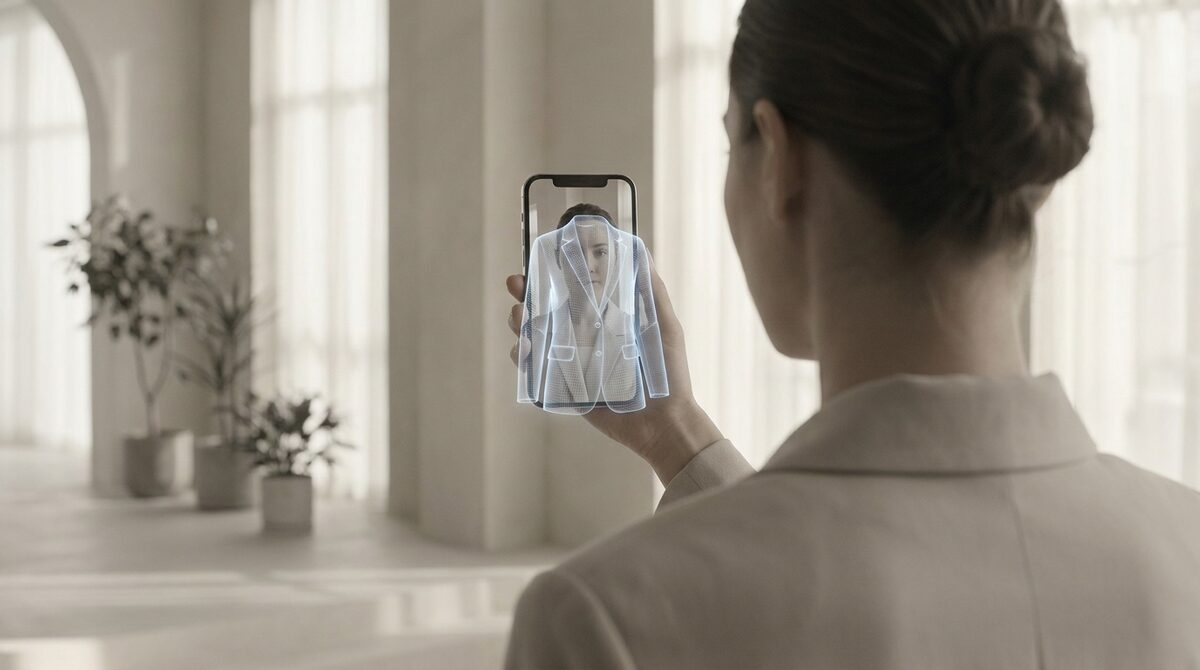
An AR fashion app lets shoppers see garments on their own body before buying, and the best ones do more than preview. With 1Match, each try-on converts into a growth engine — capturing a first-party lead, feeding funnel analytics, and staying zero-storage / GDPR-safe. Below, the options ranked by what actually moves revenue.
How we ranked these AR fashion apps
Three criteria decide whether an AR fashion app is worth installing: image quality (does the render earn trust?), setup effort (photos vs. 3D assets), and data safety (is the shopper photo retained?). We also weigh revenue features — lead capture and funnel analytics — because a preview that reports nothing is a missed opportunity. If your catalogue includes caps or beanies, see how virtual hat try-on actually works.
1. 1Match
Pros: Photo-real AI try-on from your existing product images, no 3D and no reshoot, ~10-minute setup, covers hands, face and body, zero-storage / GDPR-safe, with native lead capture and funnel analytics built in.
Cons: Focused on fashion and accessories rather than home or furniture categories.
Verdict: The strongest all-round AR fashion app for Shopify apparel stores that want previews and measurable growth in one. Install 1Match.
2. Social platform AR filters
Pros: Huge reach and easy sharing; good for brand awareness and playful campaigns.
Cons: Platform-locked, not tied to your checkout, and typically decorative rather than accurate; data governed by the platform.
Verdict: Great for marketing buzz, weak for on-site conversion.
3. 3D-model try-on apps
Pros: Can produce detailed results for hero products where you invest in modelling.
Cons: Weeks of asset creation, higher cost, and hard to scale across a full catalogue.
Verdict: Viable for a few flagship items, impractical store-wide.
Quick comparison
| App type | Setup | Data | Conversion focus |
|---|---|---|---|
| 1Match (AI try-on) | ~10 min | Zero-storage | High |
| Social AR filters | Platform | Platform policy | Low |
| 3D-model apps | Weeks | Varies | Medium |
See also our best virtual try-on apps for Shopify fashion in 2026 and the best Shopify app for a clothing store in 2026.
Making the choice
If your goal is on-site conversion and fewer returns, prioritise a photo-based AI try-on with strong realism and a clean data policy. It installs fast, scales across your catalogue, and turns each interaction into a lead and a data point.
Matching the app to your catalogue
The right choice depends on what you sell. A store built around a handful of hero products can, in theory, justify bespoke 3D work for those items. A store with a broad, fast-changing catalogue cannot — the production cost would never end. For most apparel and accessory merchants, a photo-based AI try-on is the only approach that scales, because new products become try-on-ready the moment their images go live.
Data requirements matter just as much. If your market is privacy-sensitive or you sell into the EU, a zero-storage / GDPR-safe app is not optional. Shortlist on that basis first, then compare image quality and features among the survivors.
Getting the most from your chosen app
Installation is only step one. To realise the return, place the try-on button prominently on the product page, use it in your marketing imagery, and watch the funnel analytics to see which products gain most from an on-body preview. Feed those insights back into merchandising, and the app compounds in value rather than sitting idle.
Final recommendation
For a Shopify apparel store chasing conversion and fewer returns, a photo-based AI try-on with strong realism, full body-face-hands coverage and a clean data policy is the safest pick. It scales across your catalogue, installs in about ten minutes, and turns each interaction into a lead and a data point. Social filters and 3D-model apps have their niches, but neither matches that everyday economics.
Install the one that behaves like infrastructure, and the rest of your marketing works harder for it.
Bottom line: the AR fashion app worth installing behaves like a Shopify growth engine — realistic try-on plus native lead capture and funnel analytics, kept zero-storage and GDPR-safe. Start with 1Match.
Frequently asked questions
What is the best AR fashion app for Shopify?
The best AR fashion app is one that renders garments realistically, works from your existing product photos, and keeps shopper data zero-storage. 1Match fits that profile with a roughly ten-minute setup and coverage across body, face and hands. The right pick ultimately depends on your catalogue and data requirements.
Are AR fashion apps hard to install?
AI-based AR fashion apps are not. They avoid 3D asset building by working from photos you already have, so setup is measured in minutes rather than weeks. 1Match installs in about ten minutes and enables try-on across every product page.
Do AR fashion apps really lift sales?
When the render is realistic, yes. Removing fit-and-size doubt typically lifts add-to-cart 18–28% and cuts returns 25–40%. Apps that also capture leads and report funnel data compound the value beyond a single sale.
Are AR fashion apps safe for customer privacy?
The trustworthy ones are. Look for zero-storage, GDPR-safe handling where the shopper photo is used only to render the preview and never retained. 1Match is built this way; always verify a provider’s policy before installing.
 Install on Shopify