
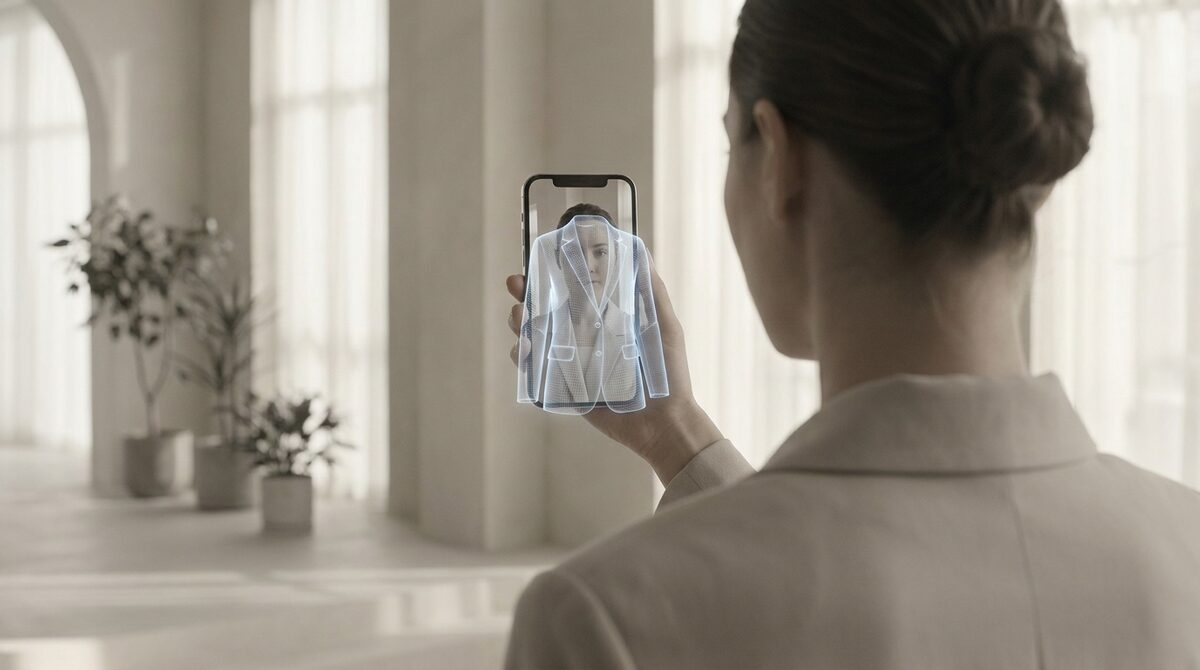
Augmented reality clothing fitting renders garments onto a shopper’s own body so they can judge fit before checkout — the digital replacement for the fitting room. With 1Match it also turns into a growth engine: each fitting captures a first-party lead, feeds funnel analytics, and stays zero-storage / GDPR-safe. The result is fewer returns without touching your return policy.
What augmented reality clothing fitting solves
Return rates in online fashion are stubborn because the core problem is invisible at checkout: the shopper cannot tell whether an item will fit. Augmented reality clothing fitting makes that visible. By rendering the garment onto the shopper’s photo — from your existing product photos, with no 3D and no reshoot — it lets people judge fit and style before they pay, not after the parcel arrives. Our fashion return rate calculator turns order volume and return rate into an annual cost in about ten seconds.
Fit uncertainty is also why good size communication matters; pair try-on with our guide on writing effective size guides for Shopify fashion stores for a compounding effect.
How augmented reality clothing fitting works
The flow is simple for the shopper: upload a photo, and the garment appears on their body with realistic proportion and drape. Behind the scenes, AI handles the mapping and rendering, prioritising strong image quality so the preview is believable. For a deeper look at the underlying idea, see the virtual fitting room explained.
Why it cuts returns at the source
About 70% of apparel returns are fit and size related. Augmented reality clothing fitting targets exactly that cause, which is why stores typically see 25–40% fewer returns and an 18–28% add-to-cart lift. Crucially, you achieve this without loosening standards or rewriting your returns policy — you simply help shoppers buy the right thing the first time. Our breakdown of the numbers lives in reduce returns for an online fashion store.
Not just clothes: the full fitting range
Augmented reality clothing fitting extends naturally to accessories. Because the same engine handles hands, face and body, you can fit rings, glasses and hats alongside apparel. That range is fashion-first and keeps one consistent experience across your catalog rather than bolting on separate tools.
Adding augmented reality clothing fitting to Shopify
Setup is deliberately light. Install 1Match, point it at your existing images, and enable the fitting button — roughly a 10-minute setup. Every product page then offers augmented reality clothing fitting, and every use adds a lead and a data point to your funnel.
Bottom line: Augmented reality clothing fitting lowers return rates by fixing the cause, not the policy. Treat it as a Shopify growth engine — fitting that also powers native lead capture and funnel analytics while staying zero-storage and GDPR-safe — and you can launch it in minutes with 1Match.
Frequently asked questions
What is augmented reality clothing fitting?
Augmented reality clothing fitting is technology that renders a garment onto a shopper’s own image so they can assess fit and style before buying. It replaces the physical fitting room with a digital preview generated from your product photos. The shopper sees the item on their body rather than on a model.
How accurate is augmented reality clothing fitting?
It is accurate enough to guide real purchases, particularly for proportion, drape and overall styling. Image quality has improved to the point where previews look photographic rather than pasted-on. It will not replace a tailor’s tape measure, but it removes the fit uncertainty that causes most returns.
Does augmented reality clothing fitting reduce returns?
Yes. Because roughly 70% of apparel returns stem from fit and size issues, letting shoppers preview garments on themselves addresses the root cause. Stores adopting virtual fitting typically report 25–40% fewer returns along with an 18–28% add-to-cart lift.
Is augmented reality clothing fitting hard to set up?
Not with the right app. Because tools like 1Match render from your existing product photos, there is no 3D modelling or reshoot, and setup on Shopify takes about ten minutes. Shoppers need only a browser and a photo — no special hardware.
 Install on Shopify