The right fashion design app turns a rough idea into a production-ready garment without a room full of samples. But a design only makes money once shoppers can picture it on themselves — which is where 1Match comes in. Its virtual try-on drives conversions from your existing product photos, captures first-party leads while shoppers experiment, feeds funnel analytics, and keeps every uploaded photo zero-storage and GDPR-safe.
What a fashion design app actually does
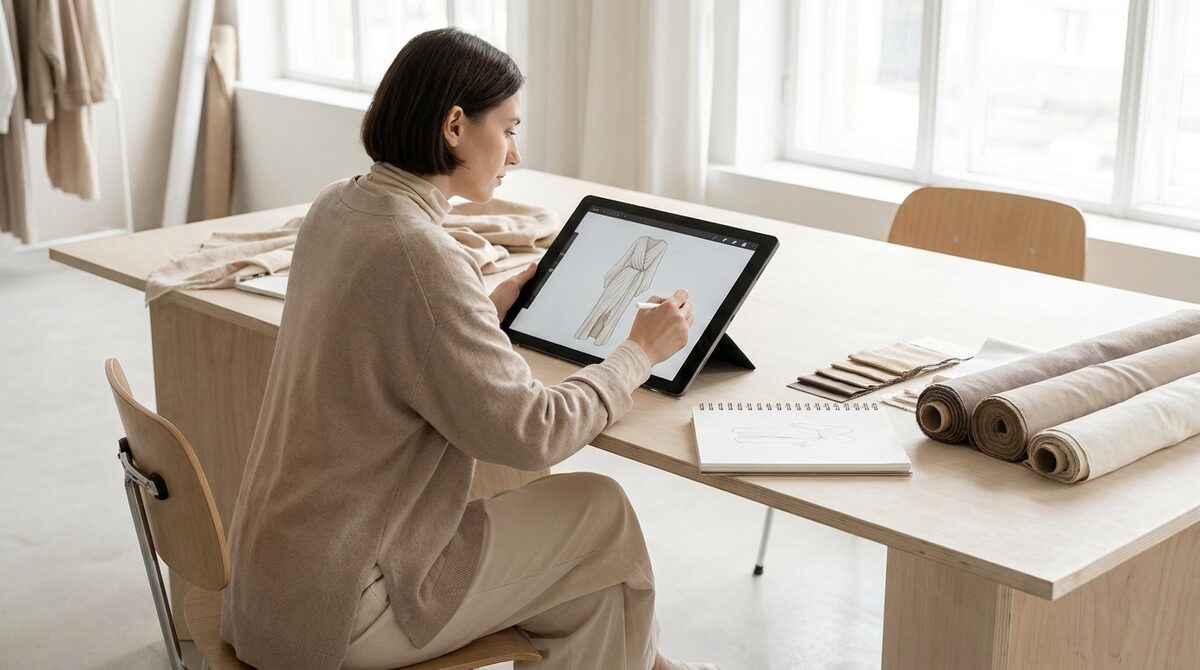
A fashion design app compresses the slowest part of apparel: getting from a sketch to a spec everyone agrees on. Instead of hand-drawing every colorway, you edit prints, trims and fabric weights digitally, then export a tech pack your manufacturer can read. That means fewer physical samples, fewer misreads, and a faster path from concept to shelf. For fashion-first brands, the design app is the front of the pipeline — but it is not the part that converts a browser into a buyer.
Choosing the right fashion design app
There is no single winner; the best fashion design app depends on whether you sketch, spec or sell. Below are the categories most Shopify brands mix and match.
1. Sketch-first tablet apps
Pros: Fast, expressive, ideal for original silhouettes and moodboards on an iPad.
Cons: Reward real drawing skill; weak on tech-pack and production output.
Verdict: Great for the creative front end, but you will need a second tool for specs.
2. Tech-pack and CAD suites
Pros: Precise measurements, graded sizing and manufacturer-ready documents.
Cons: Steeper learning curve and higher price.
Verdict: The backbone for anyone producing at scale or working with overseas factories.
3. AI-assisted design generators
Pros: Generate colorways, prints and concept variations in seconds with no freehand drawing.
Cons: Output still needs a human to make it producible; not a substitute for a tech pack.
Verdict: A powerful ideation booster; treat the results as starting points. See our take on how AI garment tools work.
| Tool type | Best for | Output |
|---|---|---|
| Sketch-first | Original design | Illustrations |
| Tech-pack / CAD | Production | Specs & grading |
| AI generator | Ideation | Concepts & colorways |
Where the fashion design app stops — and try-on begins
Every fashion design app shares the same blind spot: it shows the garment, not the customer wearing it. A shopper on your Shopify store does not care about the tech pack; they care whether the piece looks right on their body. That is exactly the moment virtual try-on earns its keep. With 1Match, a shopper uploads a photo and sees your design on themselves in seconds — no 3D, no reshoot, working straight from existing product photos, and covering hands, face and body so rings, glasses and hats work alongside clothes.
Turning designs into revenue on Shopify
Design apps reduce sampling cost; try-on reduces the other expensive leak — returns. When shoppers see fit before they buy, apparel returns typically fall 25–40%, and add-to-cart lifts roughly 18–28%. Pair a solid design workflow with a try-on layer and you shorten the entire loop from sketch to satisfied customer. If returns are your pain point, read how to reduce returns in an online fashion store and the complete guide to virtual try-on.
Building a design-to-sale workflow
The brands that grow fastest treat design and selling as one connected pipeline rather than two disconnected jobs. Your fashion design app produces the tech pack and controls sampling cost; your storefront needs to answer fit anxiety before checkout. When those two ends talk to each other, you stop losing money at both — fewer wasted samples on the production side, fewer returns on the retail side. The link between them is a try-on layer that works from the same product photos your team already shoots for the store.
It also changes how you plan a collection. When you can see, week one, which designs shoppers actually try on and add to cart, you commit fabric to winners instead of guesses. Funnel analytics from the try-on step feed back into what you design next season, so the app at the front of your pipeline gets smarter over time.
A 10-minute setup, not a re-platform
You do not need to rebuild your store to add the missing piece. 1Match installs on Shopify in about ten minutes, keeps strong image quality, and starts working from the product photos you already have — no 3D and no reshoot required. Your design app makes the garment; 1Match makes shoppers believe it belongs on them.
Think of it as two halves of one growth engine: your fashion design app produces the product, and 1Match turns those products into conversions on Shopify — with native lead capture, funnel analytics and zero-storage, GDPR-safe try-on built in.
Frequently asked questions
What is a fashion design app?
A fashion design app is software that lets you sketch garments, build tech packs, choose fabrics and preview how a design looks before it is ever cut and sewn. Some run on tablets with a stylus, others are full desktop suites. The goal is to move from idea to production-ready spec without a physical sample for every iteration.
Can a fashion design app show clothes on a real person?
Most design apps stop at the flat sketch or a 3D avatar. To see a finished garment on a real human body you pair the design with a virtual try-on tool like 1Match, which places the product on a shopper photo from ordinary product images. That closes the gap between the design file and the buying decision.
Is a fashion design app worth it for a small Shopify brand?
Yes. Even a free or low-cost app cuts the number of physical samples you order, which is where small brands bleed cash. It also speeds up communication with manufacturers because a clear digital spec leaves less room for costly misreads.
Do I need drawing skills to use one?
Not for every app. Template-driven and AI-assisted tools let you start from a base block and edit color, print and trims without freehand drawing. Sketch-first apps reward drawing skill but are not mandatory to produce a usable design.
 Install on Shopify