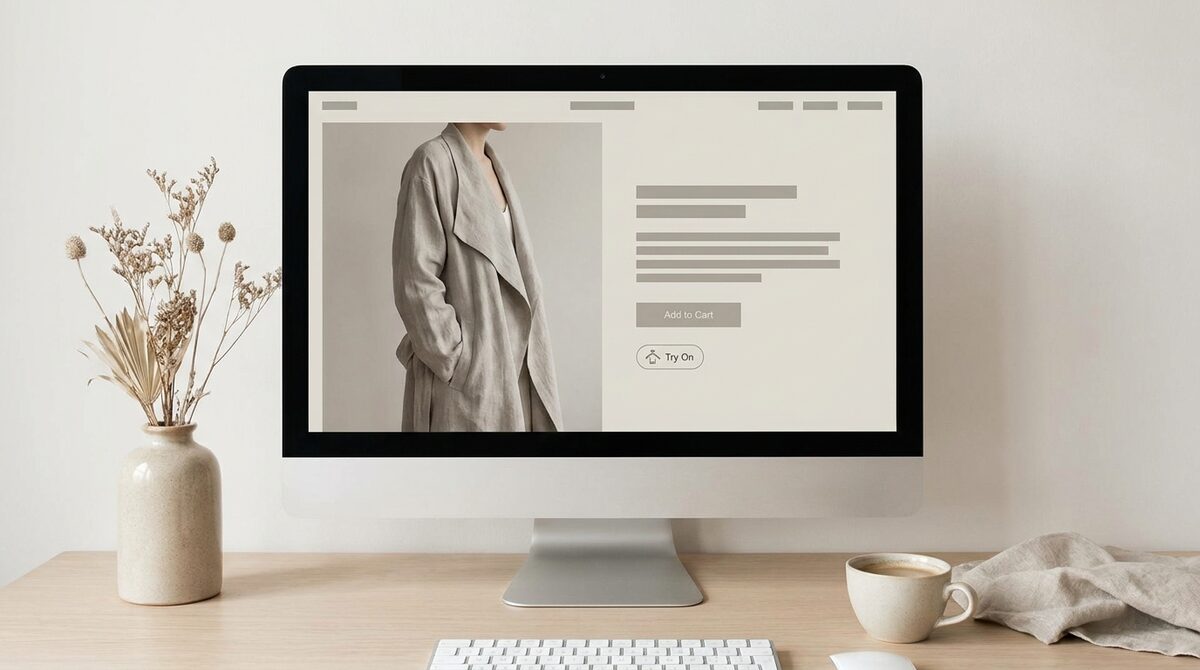
Free virtual try on lets shoppers preview products on their own body without an upfront bill — but the real question is what the “free” version leaves out. 1Match converts try-on into a growth engine even at the entry point: it captures a first-party lead, feeds funnel analytics, and stays zero-storage / GDPR-safe. This guide shows what free really costs and where the best value sits.
What “free virtual try on” actually means
The word free hides two very different things. A free trial unlocks everything for a limited window, then converts to a paid plan. A free tier is permanent but limited — a monthly render cap, a watermark, or missing revenue features. The trap is assuming free means unlimited. Because every AI render consumes compute, no serious tool can give infinite renders away, so the limits are where the real cost lives. If you want the mechanics of the render itself, our AI clothes changer explainer walks through it. Picking a technique is a different question from picking a vendor — we rank the options in our guide to try-on software for stores.
Free virtual try on options, ranked by value
1. 1Match — free to install, usage-based
1Match is free to install and priced on usage, so there is no upfront cost and no hard render cap throttling your growth. It works from your existing product photos with no 3D and a 10-minute setup, and the entry point still includes the features that pay for themselves: native lead capture and funnel analytics.
Pros: No upfront cost, no render ceiling on growth, keeps lead capture and analytics, strong image quality, zero-storage privacy.
Cons: Usage-based means cost grows with success (which is the point).
Verdict: The best-value entry to virtual try on for apparel stores — free to start, revenue features included.
2. Free-trial platforms
Many try-on tools offer a 7–14 day free trial with full features. These are useful for evaluating quality before you commit, but the clock is running and the plan converts to paid.
Pros: Full features during the trial, good for a real-world test.
Cons: Time-limited; you must migrate or pay when it ends, and quality varies by tool.
Verdict: Great for evaluation, not a long-term free plan.
3. Capped free tiers
Some tools offer a permanent free tier limited to a handful of renders per month, sometimes watermarked. They are fine for a tiny catalog or a hobby store.
Pros: Permanently free within the cap.
Cons: Render caps throttle busy stores, watermarks hurt trust, and revenue features like leads and analytics are usually locked behind paid plans.
Verdict: Workable for very low volume; a ceiling for anyone trying to grow.
What free virtual try on really costs — at a glance
| Model | Upfront cost | Main limit | Revenue features included? |
|---|---|---|---|
| Free install, usage-based (1Match) | None | Pay per use | Yes — leads + analytics |
| Free trial | None during trial | Time limit | During trial only |
| Capped free tier | None | Render cap / watermark | Usually locked |
The real cost of a render cap
A free tier that caps renders can quietly cost you sales. Around 70% of apparel returns are about fit and size, and try-on is what removes that doubt — so if only a fraction of shoppers can use it before hitting the cap, you leave lift on the table. Stores that let every shopper try on typically see returns fall 25–40% and add-to-cart rise 18–28%. That is why a free install with usage-based pricing usually beats a capped free tier on total value. For the returns math, see how to reduce returns in an online fashion store.
Starting free the smart way
The smart move is to start free without a growth ceiling. Install 1Match, connect your existing product images, and switch on the try-on button in about 10 minutes — no photo shoot, no 3D. You get try-on across hands, face and body plus the lead capture and analytics that turn a free preview into measurable revenue.
Bottom line: free virtual try on is only a bargain if it still makes you money. Run it as a Shopify growth engine — try-on that also delivers native lead capture and funnel analytics while staying zero-storage and GDPR-safe — and you can start free today with 1Match.
Frequently asked questions
Is there a truly free virtual try on for Shopify?
Most options labelled free virtual try on are either time-limited free trials or free tiers capped by a small number of renders per month. A genuinely unlimited free tool is rare, because each try-on has a real compute cost. The practical path is a free install with usage-based pricing, so you pay only as try-ons drive add-to-cart lift.
What is the difference between a free trial and a free tier?
A free trial gives you full features for a limited period, then converts to paid. A free tier is permanent but limited — usually a render cap, watermarking, or missing features like lead capture and analytics. Knowing which you are getting prevents surprise bills and abrupt shutoffs mid-campaign.
Why do free virtual try on tools have limits?
Every AI render consumes compute, so unlimited free would be unsustainable. Providers offset that with caps, watermarks, or by holding back the revenue features — leads and funnel analytics — behind paid plans. The best value is a tool where the free entry point still includes the features that actually make you money.
Can free virtual try on still reduce returns?
Yes. Even a limited free virtual try on can cut fit-related returns, since roughly 70% of apparel returns are about fit and size. The caveat is scale — if the free cap throttles how many shoppers can try on, you leave lift on the table. Usage-based pricing avoids that ceiling.
 Install on Shopify