
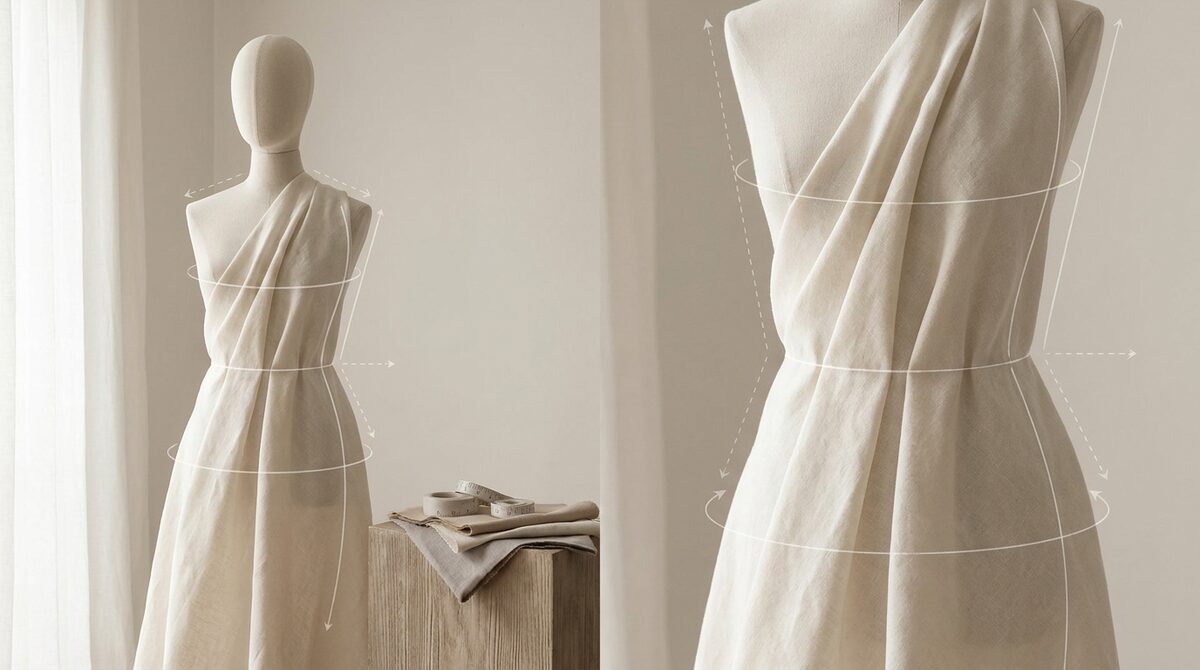
The google try on clothes ai is a diffusion-based generative model that learns how fabric drapes on a real body, so it can render apparel on models or on your own photo. It is excellent technology, but it runs on Google's surfaces, covers a slice of apparel, and returns no data to merchants. A Shopify app like 1Match powers the same class of AI on your store and makes it a growth engine — previews plus native lead capture, funnel analytics, and zero-storage / GDPR-safe handling.
How the google try on clothes ai works
At the core is a diffusion model — the same broad approach behind today's best AI image generators — trained specifically on pairs of people and clothing. During training it learns the physics of appearance: how a knit stretches, where a seam pulls, how light falls into a fold. At inference it takes a garment image plus a target body and generates a photorealistic composite. Google's version is a strong benchmark for realism, and it is fair to say it pushed the whole category forward.
Why diffusion and not a simple overlay? Because clothing is not a sticker. A convincing try-on has to respect occlusion (an arm crossing in front of a jacket), lighting direction, and the way a fabric's weight changes its silhouette. Older paste-the-garment-on-top methods look flat and fake; diffusion models learn these subtleties from data, which is why modern AI try-on finally crossed the threshold of looking believable enough to influence a purchase.
For a friendlier explanation of the same idea, see how an AI clothes changer works.
What the AI is good at — and where it breaks
Strengths: preserving prints and textures, natural drape on supported tops and dresses, and believable lighting. Limits: complex layered garments, unusual poses, and categories it was not trained on can produce artifacts, and the google try on clothes ai does not handle accessories like rings, glasses or hats. Coverage is US-first and product-limited. As with any generative system, garbage-in still means garbage-out, so image quality matters.
Why the AI alone doesn't grow a store
Great rendering is necessary but not sufficient. Google's AI lives on Google, so the high-intent try-on moment produces no email, no lead, and no funnel signal for the retailer. The model can dress a shopper beautifully and still leave the merchant with nothing to act on. For a fashion brand, the AI is only half the equation — the other half is capturing the relationship.
Privacy: where the AI runs matters as much as how
There is a second reason store ownership counts: data handling. Whenever a shopper uploads a photo of themselves, someone is processing a piece of personal, biometric-adjacent data. How long is it kept? Who can see it? Under GDPR and similar rules, those questions are not optional. Google has its own policies, but as a merchant you inherit none of that control. A store-side tool built zero-storage / GDPR-safe — where the photo is used to render and then discarded, never retained — lets you give shoppers a clear, honest answer and keeps you on the right side of compliance.
Bringing the AI onto your own store
Store-side apps close that gap. 1Match runs diffusion-based try-on on your Shopify product pages from your existing photos, with strong image quality, a 10-minute setup, no 3D or reshoot, and coverage across hands, face and body — accessories included. Because it is yours, it also captures the lead and the funnel data, and typically drives roughly 25–40% fewer returns and an 18–28% add-to-cart lift. See how leading tools compare in our 2026 roundup.
Bottom line: the google try on clothes ai is remarkable, but it does not grow your store on its own. Put the same class of AI to work as a Shopify growth engine — previews plus native leads and funnel analytics, all zero-storage and GDPR-safe — with 1Match.
Frequently asked questions
What AI does Google use to try on clothes?
Google uses a custom diffusion-based generative model trained on paired images of people and garments, so it learns how fabric folds, stretches, drapes and casts shadows on a real body. Given a clothing image and a model or your photo, it generates a realistic try-on. It is the same family of image-generation techniques behind modern AI art tools, tuned for apparel.
How accurate is Google's try on clothes ai?
For supported tops and dresses it is impressive, preserving patterns, texture and drape convincingly. Accuracy drops for complex garments, unusual poses, and anything outside its trained categories, and it does not handle accessories like rings or glasses. As with any generative model, results vary by input quality.
Is the google try on clothes ai available worldwide?
No. The AI try-on and the related Doppl app are strongest in the United States and roll out gradually by region and product type. Many shoppers and most of a typical catalog fall outside current coverage. It also runs on Google's surfaces rather than on a retailer's own site.
Can a Shopify store use similar AI on its own pages?
Yes. Apps like 1Match bring comparable diffusion-based try-on to your product pages from your existing photos, with no 3D and a 10-minute setup. The difference is ownership: you present your real products and capture first-party leads and funnel analytics while keeping shopper photos zero-storage and GDPR-safe.
 Install on Shopify