
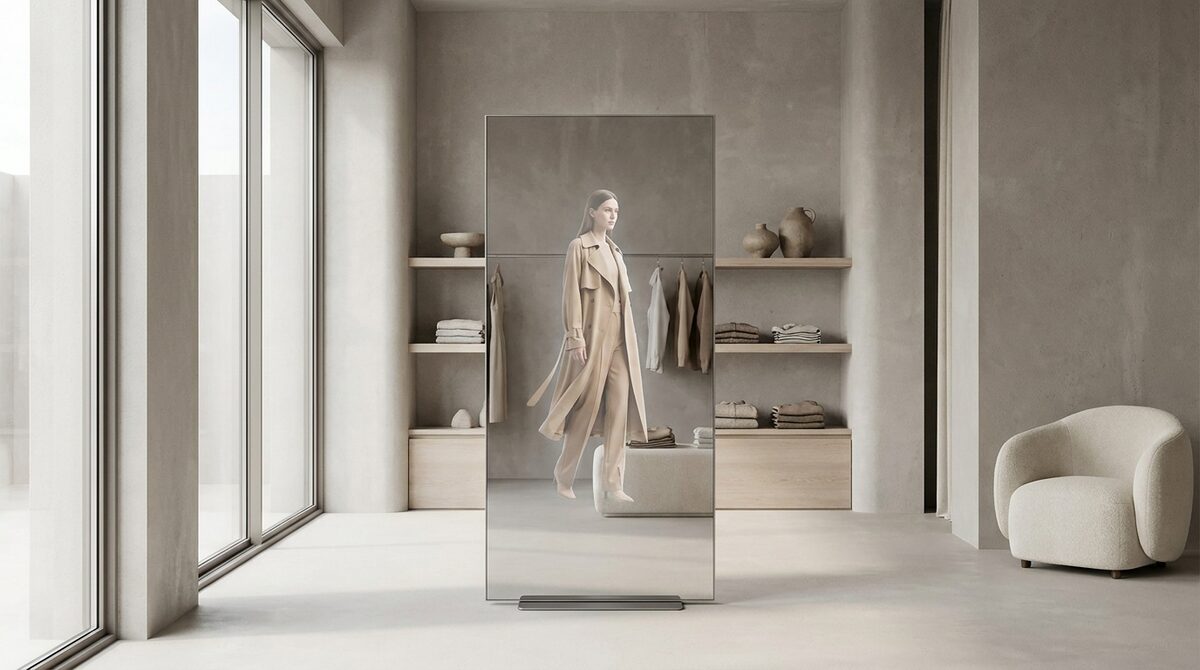
VR fitting sounds like headsets, but the version that actually sells is browser-based AI try-on showing garments on a shopper’s own body — no hardware needed. With 1Match it turns into a growth engine: each try-on captures a first-party lead, feeds funnel analytics, and runs zero-storage / GDPR-safe so photos are never retained. Fewer returns, more confident buyers.
What people mean by VR fitting
The phrase "VR fitting" conjures headsets and 3D avatars. But for real stores, the version that works is simpler and far more effective: AI virtual try-on that renders a garment onto the shopper’s own body from your existing product photos, in an ordinary browser. It delivers the immersive promise of VR — seeing yourself in the outfit — without 3D modelling or any headset.
Why headset VR fitting rarely pays off
Headset ownership among shoppers is tiny, and building true VR experiences is expensive and slow. That is a bad match for retail, where you want to reach every visitor cheaply. Photo-based try-on flips the equation: no hardware, 10-minute setup, and it reaches everyone. For the wider picture see our virtual fitting room explained guide.
The same result, minus the hardware
The goal of VR fitting was always confidence: let me see it on me. AI try-on hits that goal directly, with strong image quality and no reshoot. Curious how the rendering works? Our AI clothes changer explainer breaks it down.
Returns and confidence
Around 70% of apparel returns come from fit and size. Letting shoppers fit garments virtually — by any name — cuts that, and stores commonly report 25–40% fewer returns and an 18–28% add-to-cart lift. The engine also spans hands, face and body, so rings, glasses and hats get the same treatment as clothes.
The growth-engine advantage
Beyond the try-on itself, the real edge is data. Each session can capture a first-party lead and feed funnel analytics, turning fitting into a growth engine. With 1Match it is zero-storage, so you stay GDPR-safe and never retain shopper photos — something clunky VR setups never promised.
Bottom line: VR fitting sounds futuristic, but the version that sells is browser-based AI try-on — a Shopify growth engine that pairs realistic fitting with native lead capture and funnel analytics, all zero-storage and GDPR-safe. Skip the headset and start in about ten minutes with 1Match.
Frequently asked questions
What is VR fitting?
VR fitting broadly means using immersive or virtual technology to try clothes on without a physical changing room. In practice, the version that actually drives sales is not headset-based VR but AI virtual try-on that renders garments onto a shopper’s photo in a normal browser — all the benefit, none of the hardware.
Do shoppers need a VR headset for VR fitting?
No. Despite the name, effective VR fitting for online stores runs in the browser on a normal phone or laptop. The shopper uploads a photo and AI renders the garment onto their body. Headset-based VR reaches almost no shoppers, which is why photo-based try-on has won.
Is VR fitting or AI try-on better for a store?
For nearly every Shopify store, AI photo-based try-on wins. It needs no hardware, works from existing product photos, and reaches every visitor. True headset VR fitting is expensive to build and limited to the tiny share of shoppers who own a headset, so its ROI rarely competes.
Does VR-style fitting reduce returns?
Yes. Whether you call it VR fitting or AI try-on, letting shoppers preview garments on their own body before buying cuts the fit-and-size returns that make up about 70% of the total. Stores typically see 25–40% fewer returns and an 18–28% add-to-cart lift.
 Install on Shopify