
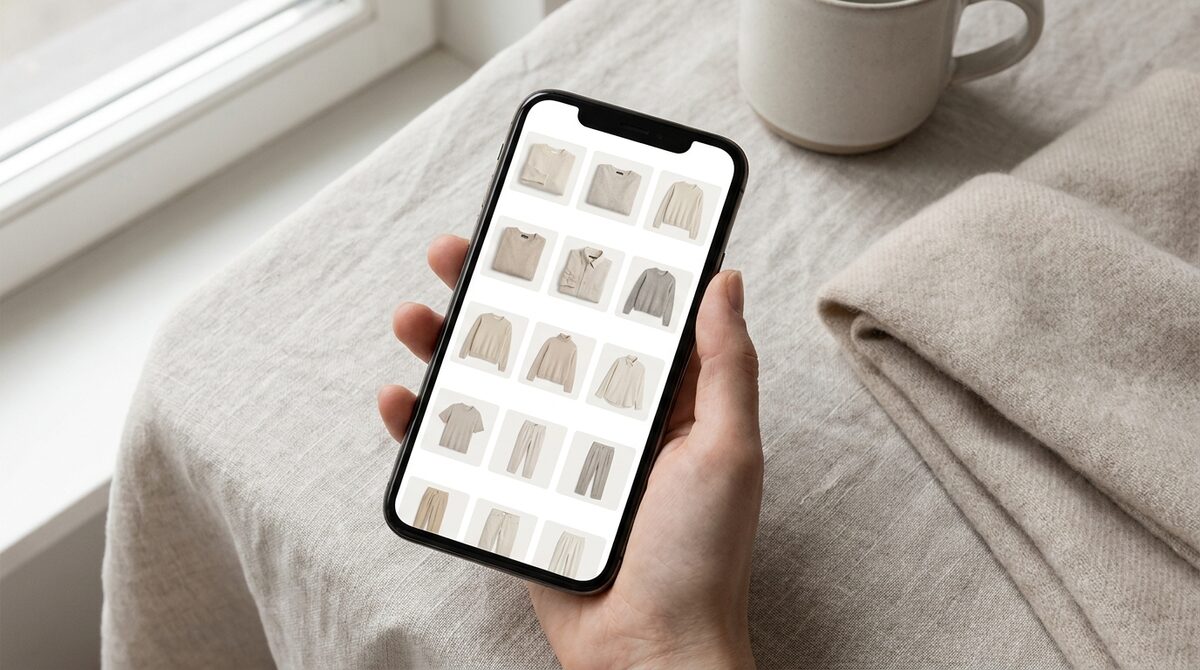
A virtual closet app lets shoppers gather garments into a digital wardrobe and preview them on their own body. On Shopify, the version that matters converts: it powers AI try-on, captures first-party leads, drives funnel analytics and keeps every uploaded photo zero-storage and GDPR-safe. In short, a virtual closet app can be a growth engine, not just a mood board.
What a virtual closet app is
A virtual closet app digitizes clothing so it can be browsed, combined and previewed without physical garments. Consumer versions catalogue what you own. The retail version is more interesting: it lets a shopper pull items from your live catalogue into a personal closet and, crucially, try them on with a photo of themselves. Because the try-on runs on strong image quality from your existing product shots, the preview is convincing enough to drive a decision.
Virtual closet app meets virtual try-on
The magic happens when the closet and the fitting room merge. A shopper assembling a virtual closet is already curating intent; adding try-on turns that curation into confidence. Our explainer on how an AI clothes changer works breaks down the underlying technology - garment mapping onto a real body across hands, face and body, from rings and glasses to hats and full outfits.
The commercial case for a virtual closet app
Fit uncertainty causes roughly 70% of apparel returns. A virtual closet app with try-on tackles that directly, and the numbers follow: about 18-28% more add-to-carts and 25-40% fewer fit-driven returns. Because 1Match needs no 3D and no reshoot, the cost side stays low while the conversion side climbs. That is the whole point of try-on ROI on Shopify.
Setting up a virtual closet app on Shopify
Installation takes about 10 minutes. Connect the app, let it read your catalogue, and shoppers can immediately build and try on a virtual closet from photos you already published. No modeling, no scanning, no photo retention.
From closet to conversions
What separates a toy from a tool is the data layer. Each session in the virtual closet app is a high-intent signal you can capture as a native lead and analyze in your funnel - which garments got tried, which converted, which stalled. That turns a fun feature into revenue you can measure.
Where a virtual closet app fits in the shopper journey
Think about how someone shops for clothes online. They arrive from an ad or search, browse a few products, and hit the same wall every time: uncertainty about how an item will actually look on them. Most stores answer that wall with a size chart and a hopeful description. A virtual closet app answers it with evidence - the shopper on their own photo, wearing the piece. That single change reframes the whole journey from "should I risk it?" to "yes, that works." The strong image quality is what makes the evidence credible; a blurry or distorted render would do the opposite.
Because the experience is fashion-first and covers hands, face and body, a virtual closet app is not limited to tops and dresses. Rings, glasses, hats and accessories all benefit, which means a store with a mixed catalogue can offer a coherent try-on experience across categories instead of bolting on separate tools. That breadth is part of why the retail version of a virtual closet app outperforms narrow, single-category widgets.
Avoiding the common virtual closet app mistakes
The biggest mistake is treating a virtual closet app as a decoration. Installed and forgotten, it adds little. Used deliberately - featured on product pages, promoted in email, and monitored through funnel analytics - it becomes a lever you can pull. The second mistake is ignoring privacy. If shoppers suspect their photos are being stored or reused, they will not upload, and the whole feature collapses. Zero-storage, GDPR-safe processing removes that hesitation and keeps upload rates high.
A virtual closet app should do more than look good; it should sell, capture leads, feed analytics and protect privacy. That combination is exactly what makes 1Match a Shopify growth engine rather than a gimmick.
Frequently asked questions
What is a virtual closet app?
A virtual closet app is software that assembles clothing into a digital wardrobe you can browse and combine. For retailers, the most powerful version pairs the closet with AI try-on so shoppers see items on their own body before buying.
How is a virtual closet app different from a virtual fitting room?
A virtual closet app focuses on collecting and organizing garments; a virtual fitting room focuses on trying them on. 1Match blends both: shoppers build a closet from your catalogue and preview each piece on themselves in seconds.
Can a virtual closet app work from my existing product photos?
Yes. 1Match generates try-ons directly from the photos you already have - no 3D, no reshoot, about 10 minutes to set up on Shopify - so your virtual closet app is live without a new production pipeline.
Is a virtual closet app safe for customer data?
With 1Match, yes. It is zero-storage and GDPR-safe, meaning shopper photos are processed for the try-on and not retained, so your virtual closet app stays privacy-compliant.
 Install on Shopify