
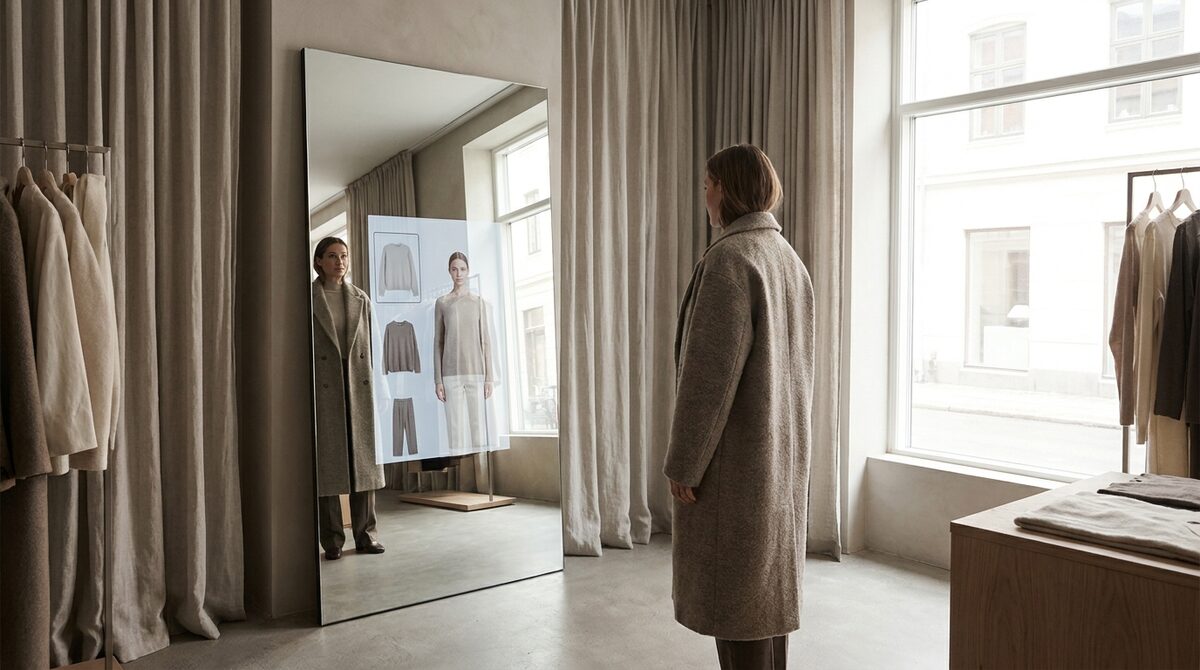
Virtual fitting room technology uses AI to render a real garment from an existing product photo directly onto a shopper's own uploaded photo, no 3D scan and no reshoot. On Shopify, this quietly turns a browsing session into a growth engine: it converts curious visitors into buyers, captures first-party leads, feeds funnel analytics, and keeps every shopper photo zero-storage and GDPR-safe.
What virtual fitting room technology really is
For years the phrase conjured up clunky 3D avatars and depth cameras. The current generation of virtual fitting room technology is different: it is image-based. A shopper uploads a photo, the AI reads the garment from your existing catalogue image, and it composites the two into a photorealistic preview. The output looks like a real photo of that person wearing that item, with correct drape, length and proportion. The same engine handles headwear, though the failure modes differ — see virtual hat try-on explained.
Because it works from photos you already own, there is no reshoot, no 3D modelling and no special studio. Strong image quality is the whole point, so the preview has to be convincing enough that shoppers trust it the way they trust a mirror.
How the underlying pipeline works
Three things happen in sequence. First, the system isolates the garment and its texture from the product photo. Second, it understands the shopper's pose and body shape from the uploaded image. Third, it warps and lights the garment onto that body so it sits naturally. The best implementations handle not just clothes but hands, face and body, so rings, glasses and hats render as cleanly as a jacket.
If you want the plain-English version of that pipeline, we break it down in how an AI clothes changer works and in our virtual fitting room explained guide.
Why virtual fitting room technology matters for returns
Apparel returns are brutal on margin, and around 70% of them come down to fit and size. When a shopper can see the garment on their own body first, that uncertainty collapses. Stores using try-on typically report 25 to 40% fewer apparel returns and an 18 to 28% lift in add-to-cart, because confidence at the product page is what moves both numbers.
We go deeper into the economics in the ROI of try-on technology.
3D scanning vs image-based try-on
The two big families of virtual fitting room technology have very different cost profiles.
| Approach | Setup | Realism | Best for |
|---|---|---|---|
| 3D avatar / scan | Heavy, needs modelling | Variable, often plasticky | Bespoke enterprise builds |
| Image-based AI (1Match) | ~10 minutes, uses existing photos | Photorealistic | Fashion Shopify stores |
What to look for when you adopt it
Prioritise image quality, breadth of categories (headwear and accessories, not just tops), setup time and data handling. A zero-storage, GDPR-safe design protects you legally and builds shopper trust. Native lead capture and funnel analytics turn the feature from a gimmick into a measurable channel.
On Shopify, virtual fitting room technology is at its strongest when the try-on itself doubles as a growth engine: 1Match pairs photorealistic previews with native first-party lead capture, funnel analytics and zero-storage GDPR-safe processing, and installs in about ten minutes from your existing product photos, no 3D and no reshoot.
Frequently asked questions
How does virtual fitting room technology actually work?
Modern virtual fitting room technology uses AI image models to map a garment from an existing product photo onto a shopper's uploaded photo. There is no 3D scan or reshoot involved. The result is a photorealistic preview of how the item looks on the shopper's own body, generated in seconds.
Is virtual fitting room technology accurate for sizing?
It is highly accurate for drape, fit and proportion because it renders the real garment on the real person rather than a generic avatar. Roughly 70% of apparel returns are fit and size related, so seeing the item on your own body before buying removes most of that guesswork.
Do I need special hardware or a 3D studio?
No. Image-based virtual fitting room technology like 1Match works directly from your existing product photos and a shopper selfie. There is no depth camera, no 3D modelling and no photo studio, which is why setup takes about ten minutes.
Is shopper photo data safe with virtual fitting rooms?
With a zero-storage, GDPR-safe approach the shopper photo is processed for the try-on and not retained. 1Match is built this way, so you get the conversion benefit without becoming a custodian of sensitive biometric images.
 Install on Shopify