
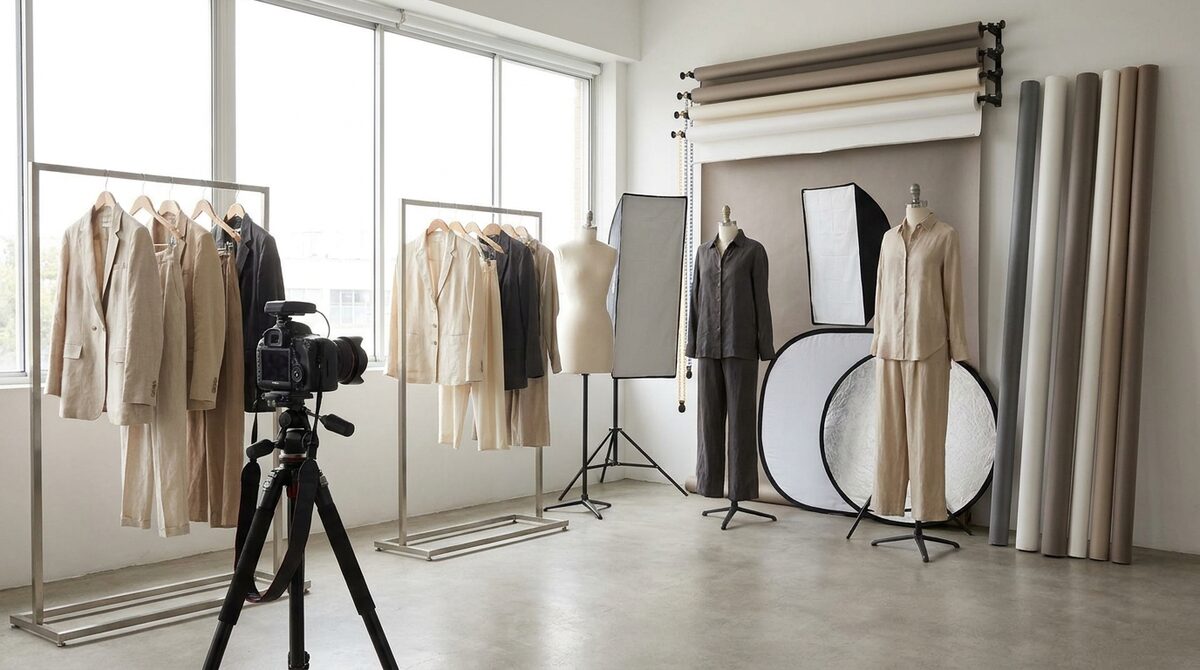
AI product photography uses generative models to create studio-grade product images from a simple photo, with no set, no lighting rig, and no reshoot. For fashion stores it does more than pretty pictures: paired with a virtual try-on app like 1Match, the same clean product photos become a growth engine that converts browsers on their own body, captures first-party leads, feeds funnel analytics, and keeps every shopper photo zero-storage and GDPR-safe.
What AI product photography actually does
Traditional apparel shoots are slow and expensive: models, studio time, retouching, and a full reshoot every time you change a background or a season. AI product photography compresses that pipeline. You start from what you already have — a flat lay, a mannequin frame, or a phone photo — and the model generates clean, consistent output. Because it works from existing product photos, you skip the reshoot entirely and keep strong image quality across your whole catalog.
The keyword to remember is consistency. A store with 300 SKUs shot on ten different days looks messy. AI product photography lets you standardize lighting, framing, and background so the catalog reads as one brand, which quietly lifts trust and add-to-cart.
Where AI product photography wins for fashion
Fashion is the hardest and most rewarding category. Shoppers judge fabric, drape, and fit from a thumbnail. Good AI imagery preserves texture and color while removing the friction of studio logistics. The biggest wins are background replacement, on-model rendering, and fast variant generation — producing every color of a shirt without shooting every color.
It is not magic. Intricate prints, reflective materials, and tiny embroidered logos still need a human eye. Treat AI as a fast first draft you approve, not an unattended printer.
AI product photography vs a traditional shoot
| Factor | Traditional shoot | AI product photography |
|---|---|---|
| Setup time | Days to weeks | Minutes |
| Cost per SKU | High | Very low |
| Variant images | Reshoot each | Generate instantly |
| Best for | Hero campaigns | Catalog scale |
From photo to fitting: closing the loop
Clean images are step one. The real leverage comes when those images become interactive. This is where AI product photography and AI try-on meet. A shopper does not just see the garment on a stock model — they see it on their own body. That is a different psychological event, and it is what actually moves the conversion and returns numbers.
If you want the mechanics, our guide to how an AI clothes changer works breaks down the rendering step, and the virtual fitting room explained piece covers the shopper experience end to end.
The business case: returns and add-to-cart
Roughly 70% of apparel returns are fit or size related, and returns quietly eat margin. When shoppers see a garment on themselves before buying, guesswork drops. Stores using virtual try-on typically report 25–40% fewer apparel returns and an 18–28% lift in add-to-cart. AI photography makes the imagery cheap to produce; try-on makes it earn. For the full financial picture, see our breakdown of try-on ROI on Shopify.
How to start without over-investing
Begin with your top 20 sellers. Standardize their AI-generated imagery first, then layer try-on on those same products so you can measure the lift cleanly. A 10-minute setup with no 3D modeling and no reshoot means you can test the whole idea before committing your catalog. Because 1Match works across hands, face and body — rings, glasses, hats and clothes — the same approach scales beyond apparel into accessories.
AI product photography stops being a cost line and becomes a Shopify growth engine when the picture that sells is also the picture that fits: try-on on the shopper's own body, native lead capture, funnel analytics, and zero-storage, GDPR-safe handling of every photo. You can add it in an afternoon with 1Match.
Frequently asked questions
What is AI product photography?
AI product photography uses generative models to create or enhance product images without a full photo studio. You feed in a basic photo or a flat garment shot, and the AI produces clean backgrounds, consistent lighting, and lifelike detail. For fashion, it can even place a garment on a model or a real shopper's body.
Is AI product photography good enough for a real store?
For most Shopify apparel stores, yes. Modern models handle fabric texture, folds, and color accuracy well enough for catalog and listing images. The main limits are complex fabrics and very fine logos, so brands usually review outputs before publishing rather than posting blind.
Does AI photography replace a photographer?
It replaces a lot of repetitive studio work, not the creative direction. Photographers still matter for hero campaigns and brand storytelling, but for the hundreds of routine catalog angles, AI is faster and far cheaper. Many teams use a hybrid: shoot a few real frames, then scale with AI.
How does AI photography connect to virtual try-on?
They share the same foundation. Once you have clean product images, an AI try-on tool like 1Match can render those exact garments on a shopper's own photo, so the picture that sells is also the picture that fits. That closes the loop between imagery and conversion.
 Install on Shopify