
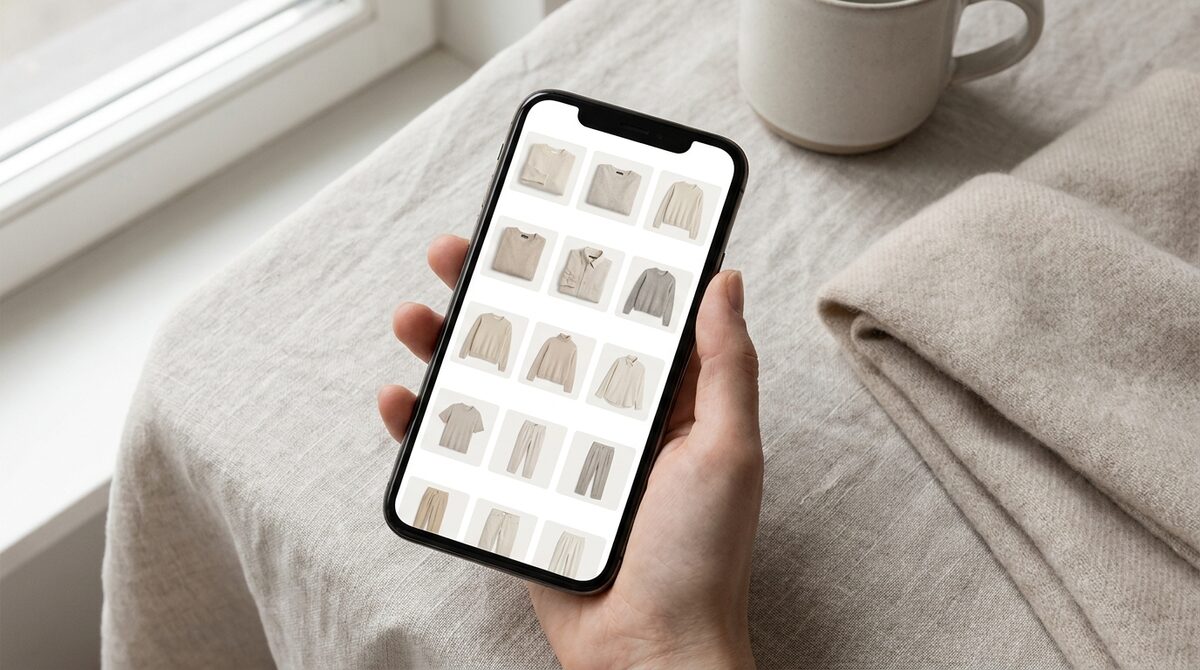
A digital closet app turns real clothing into a browsable digital wardrobe. On Shopify, the version that pays for itself pairs that wardrobe with AI try-on: it converts shoppers, captures first-party leads, powers funnel analytics and keeps every photo zero-storage and GDPR-safe. Understanding both the informational and commercial sides helps you choose the right one.
How a digital closet app works
At its core, a digital closet app represents garments as digital assets you can view, combine and preview. Consumer versions rely on you photographing your own clothes. Retail versions skip that step entirely - they pull from a store's catalogue and, with strong image quality, render each garment on the shopper. No 3D scan, no reshoot; the app works from product photos that already exist.
Informational vs. commercial: two reasons people search
Some people want to understand a digital closet app so they can organize their own wardrobe. Others - store owners - want to know whether it can sell. Both are valid, and the honest answer is that the retail version is where the money is. Our complete guide to virtual try-on bridges the two perspectives.
What a digital closet app does for a store
The retail case is straightforward. Fit and size doubt drive around 70% of apparel returns; a digital closet app with try-on resolves that doubt on the shopper's own body, across hands, face and body. Stores see roughly 18-28% higher add-to-cart and 25-40% fewer fit-driven returns. See the ROI breakdown for the full math.
Getting a digital closet app live on Shopify
Setup is about 10 minutes with 1Match. Install, connect your catalogue, and the try-on renders from your existing photos. There is no modeling pipeline and no shopper-photo retention to manage - privacy is handled by default. That low barrier is why a digital closet app is now realistic for stores of any size, not just large brands with production budgets. A five-product boutique and a five-thousand-SKU retailer follow the same short path to going live, and both draw on photos they have already published.
The growth-engine layer
Beyond try-on, a digital closet app can capture each session as a native lead and feed which garments were tried, kept or abandoned into funnel analytics. That is what upgrades it from an organizing tool to a growth engine you can measure.
Digital closet app vs. traditional product pages
A traditional product page asks the shopper to imagine. It shows a garment on a model, lists dimensions, and hopes the customer can bridge the gap to their own body. A digital closet app closes that gap directly. Instead of imagining, the shopper sees. That difference sounds small but it reorganizes the entire decision: doubt is replaced by evidence, and evidence converts. For categories where fit is subjective - fitted dresses, tailored jackets, statement accessories - the gap a digital closet app closes is exactly where sales are usually lost.
There is also a merchandising benefit. A digital closet app encourages shoppers to try combinations, which surfaces products they might never have clicked from a grid. Cross-sell stops being a banner you bolt on and becomes a natural part of exploring the closet. That is a subtler lever than the headline conversion lift, but over thousands of sessions it compounds.
Getting the most from a digital closet app
To get real value, treat the digital closet app as a first-class part of the store, not a hidden widget. Feature it prominently on high-traffic product pages, mention it in post-click emails, and review its funnel analytics regularly to see which garments drive the most try-ons and conversions. Because the tool is zero-storage and GDPR-safe, you can promote it confidently without privacy caveats - an advantage when shoppers are increasingly wary of how their images are used.
Whether you are researching or ready to sell, a digital closet app earns its place when it combines try-on, native leads, funnel analytics and zero-storage privacy. That is the 1Match approach on Shopify.
Frequently asked questions
What does a digital closet app do?
A digital closet app converts physical clothing into a browsable digital wardrobe. For retailers, the strongest version adds AI try-on so shoppers preview store items on their own body before buying.
Is a digital closet app worth it for a small Shopify store?
Yes. Because 1Match works from existing product photos with no 3D and a 10-minute setup, even small stores can add a digital closet app experience cheaply and see add-to-cart and returns improve.
How does a digital closet app reduce returns?
By removing fit uncertainty. When a digital closet app lets shoppers try garments on their own photo, they buy items that actually suit them, cutting fit-driven returns by roughly 25-40%.
Does a digital closet app keep customer photos?
With 1Match, no. It is zero-storage and GDPR-safe: shopper images are processed to render the try-on and not retained, keeping your digital closet app privacy-compliant.
 Install on Shopify