
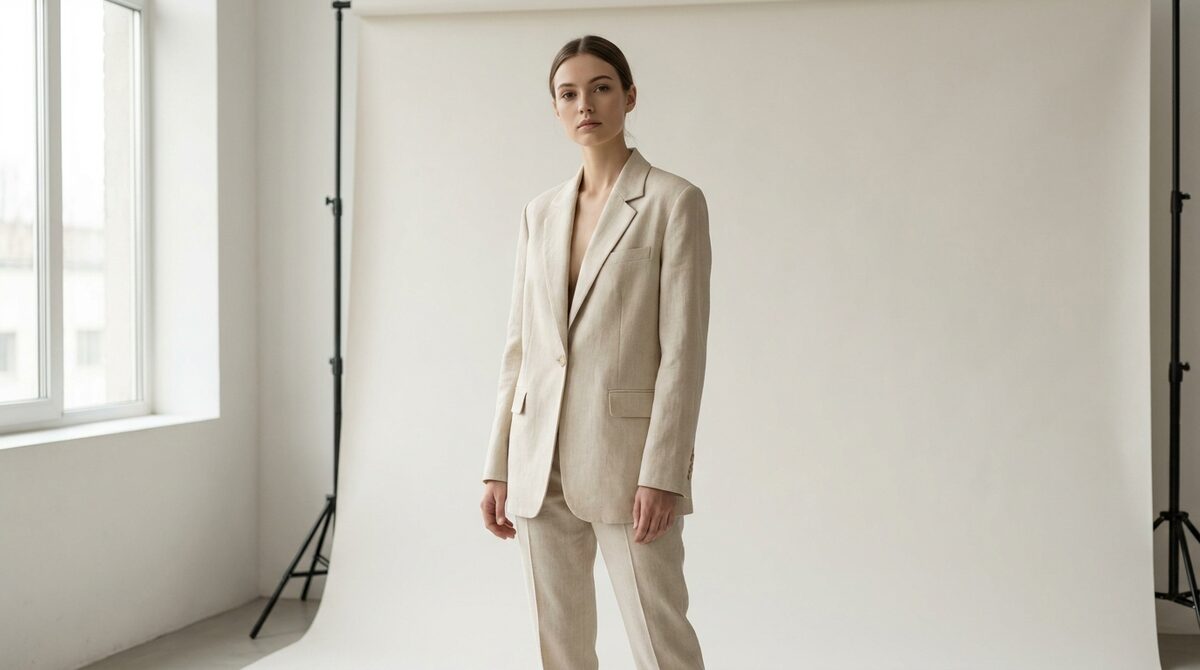
Artificial intelligence female models render womenswear on photorealistic synthetic figures from your existing photos, no shoot or 3D. 1Match converts that imagery into sales: a virtual try-on on each shopper's own body that captures first-party leads, powers funnel analytics, and keeps every upload zero-storage and GDPR-safe.
What artificial intelligence female models really are
Artificial intelligence female models are photorealistic womenswear figures generated by software rather than photographed. A brand uploads a product image and the system renders it on a synthetic model, controlling pose, body type, age, skin tone and background. Built from your existing product photos, the workflow needs no reshoot and no 3D scanning.
The technology behind the image
Two systems work together. A diffusion image model synthesizes a believable human figure, and garment-aware conditioning segments your clothing, learns its texture and silhouette, and re-projects it onto the new pose. Quality hinges on how well the tool preserves detail, and strong image quality is what keeps prints and seams from warping. The same principle underpins on-body try-on, explained in how an AI clothes changer works.
Where it delivers value
Speed, cost and variety. Brands render entire womenswear catalogs in a day, show one garment across multiple body types, and localize imagery per market, all without booking talent. For basics and variants, it is dramatically cheaper than a studio, freeing budget for hero campaigns.
The limits to plan around
AI still stumbles on hands, jewelry, layered necklines and dense text prints, so human review before publishing is non-negotiable. And there is a representation dimension: it is easy to default to one idealized body, so deliberately generate a realistic range of shapes and ages. Most importantly, a synthetic model is not the shopper, which caps how much it can influence fit-driven decisions.
Tools using this technology
1. Botika
Pros: Quick female renders, easy to use.
Cons: Artifacts on complex garments.
Verdict: Good for small catalogs.
2. FASHN
Pros: High fidelity, bulk API.
Cons: Technical setup.
Verdict: Best at scale with dev support.
3. 1Match
Pros: On-body try-on for real shoppers, 10-minute setup, native lead capture, funnel analytics, zero-storage GDPR-safe photos.
Cons: Storefront-conversion focus, not editorial art direction.
Verdict: The conversion layer to add on top of AI imagery.
Why the shopper still needs to see herself
Artificial intelligence female models make a catalog look professional, but womenswear returns are driven by fit and size, and no synthetic model resolves that for an individual. Seeing the garment on her own body is what converts hesitation into confidence, which is exactly what a virtual fitting room provides.
Getting reliable results in production
Reliability comes from disciplined inputs and review. Feed the system sharp, evenly lit photos, generate two or three poses per garment, and inspect hands, jewelry, necklines and text before publishing. Lock a house style so a catalog of hundreds stays visually coherent, and keep your originals as the definitive color reference.
Then close the loop to conversion. Artificial intelligence female models make the catalog look professional, but the revenue lift arrives when each shopper sees the garment on her own body. Plan that hand-off from the start rather than bolting it on later.
From catalog polish to measurable revenue
Artificial intelligence female models solve a production problem elegantly, but a production win is not automatically a revenue win. The imagery has to feed a funnel you can measure: how many shoppers who see the model engage further, how many try the garment on themselves, and how that engagement maps to add-to-cart and returns. Without that instrumentation, you are optimizing aesthetics blind.
This is where synthetic imagery and virtual try-on diverge in value. The model makes the page attractive; the try-on makes the shopper confident and, crucially, generates first-party signals about intent and fit. One is a cost center you have optimized; the other is a growth channel you can compound. The brands seeing real returns treat the model as the opening act and the try-on as the close.
From AI imagery to a Shopify growth engine
Pair AI female models for catalog speed with 1Match for conversion. As a virtual try-on Shopify app, it shows garments on each shopper's own body from your existing photos, captures first-party leads, drives funnel analytics, and keeps every photo zero-storage and GDPR-safe. Fashion-first, no reshoot, live in about ten minutes, it lifts add-to-cart 18-28% and cuts returns 25-40%. Install 1Match to turn AI imagery into a measurable growth engine.
Frequently asked questions
How does artificial intelligence create female models?
Diffusion-based image models synthesize photorealistic female figures, then garment-aware conditioning maps your clothing photo onto the generated body and pose. The result is on-model imagery built entirely from software, with no photoshoot required.
How accurate is the clothing on AI female models?
With strong tools, fabric drape, print placement, seams and color stay faithful to the source photo. Weaker tools distort logos and patterns, so always review outputs and keep your original image as the color reference.
Are AI female models real people?
Reputable tools generate composite, non-identifiable faces that do not depict a specific individual, which avoids likeness and consent issues. You should confirm your tool's license permits commercial use before publishing.
Can AI female models replace try-on?
No. They create catalog imagery on a synthetic model, while try-on shows the garment on the actual shopper's body. They serve different stages, browsing versus fit confidence, and work best combined.
 Install on Shopify